-

sales@tujinmagnet.com
-

+86-18858010843
Content
NdFeB magnets remain magnetically stable at elevated temperatures when they are produced from higher coercivity grades, such as H, SH, UH, or EH series material, which resist demagnetization far better than standard N-series grades under heat and load. This is the direct reason motor designers across new energy vehicles, industrial automation, and home appliances specify high-temperature NdFeB magnets rather than standard grade material for applications where the rotor or magnet assembly routinely operates above 100 degrees Celsius. As a neodymium magnets manufacturer focused on motor-grade material, Ningbo Tujin Magnetic Industry Co., Ltd. produces NdFeB magnets engineered to maintain performance across a working range of approximately negative 40 degrees Celsius to 200 degrees Celsius or higher, depending on the grade selected. Choosing the correct grade, shape, and coating combination for a given motor design is what ultimately determines whether a magnet will hold its magnetic output reliably over the product's operating life rather than losing performance prematurely under thermal and demagnetizing stress. The sections below explain how NdFeB composition, grade selection, shape, and coating each contribute to that outcome, along with the industries and applications where these considerations matter most.
NdFeB magnets are sintered from an alloy of neodymium, iron, and boron, with additional elements such as dysprosium or terbium often introduced to raise the material's intrinsic coercivity, which is the property that governs resistance to demagnetization at elevated temperature. As a general reference point widely discussed in permanent magnet engineering literature, including technical data commonly published by magnet material standards bodies such as IEC 60404-8-1, NdFeB material is grouped into temperature-rated series that indicate the maximum recommended working temperature for each grade. Standard N-series grades are generally limited to lower operating temperatures, while M, H, SH, UH, and EH series grades progressively extend the usable temperature range by trading some maximum energy product for higher intrinsic coercivity. Selecting a grade purely for its room-temperature magnetic strength without accounting for the actual operating temperature of the motor is one of the most common design mistakes in magnet specification, since a magnet can perform well on the bench yet demagnetize partially once installed inside a hot motor housing. This is why a custom NdFeB magnets supplier working closely with a customer's motor design team, rather than simply supplying off-the-shelf grades, is generally better positioned to recommend the correct balance of temperature grade, shape, and coating for the intended application.
| Grade Series | Typical Max Working Temp | Relative Coercivity | Common Use Case |
|---|---|---|---|
| N Series | Up to about 80 C | Lower | General consumer devices |
| M Series | Up to about 100 C | Moderate | Small appliance motors |
| H Series | Up to about 120 C | Higher | Servo motors, BLDC motors |
| SH Series | Up to about 150 C | High | EV traction motors, hub motors |
| UH and EH Series | Up to about 180 to 200 C or higher | Very high | Traction motors, turbines, heavy machinery |
Moving from a standard N-series grade to an SH, UH, or EH series grade generally involves a tradeoff, since higher coercivity grades typically carry a somewhat lower maximum energy product compared with standard grades at room temperature. For motor designs that operate consistently near or above 120 degrees Celsius, such as EV traction motors or industrial servo motors under continuous load, this tradeoff is usually well justified because the higher coercivity grade prevents the partial demagnetization that would otherwise occur in a lower grade magnet under the same thermal conditions. A rare earth magnets manufacturer with in-house grade testing capability can help customers validate that a selected grade will actually meet the demagnetization margin required for their specific motor operating envelope, rather than relying solely on published datasheet values.
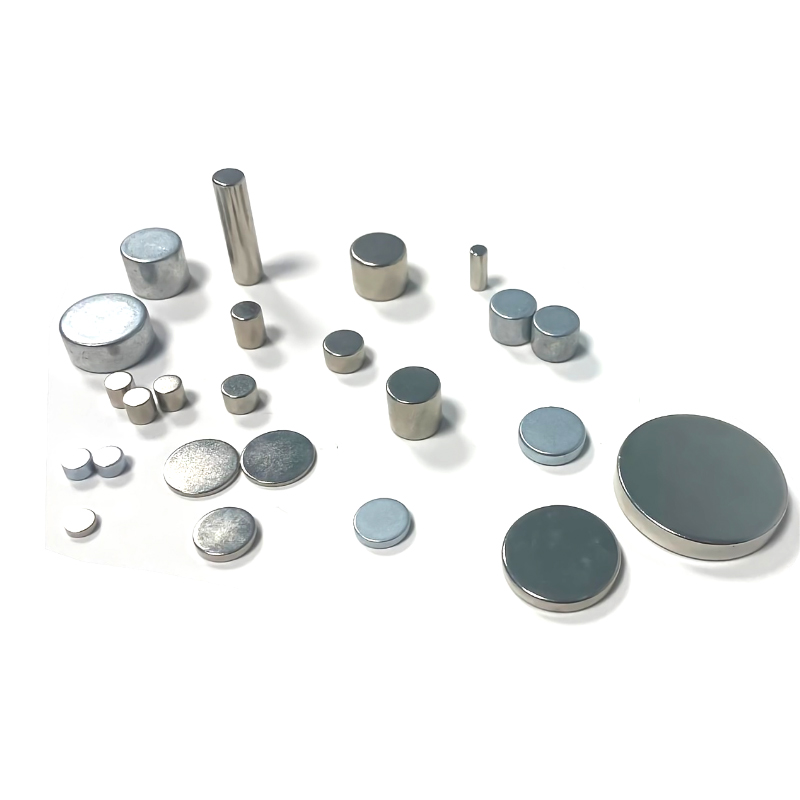
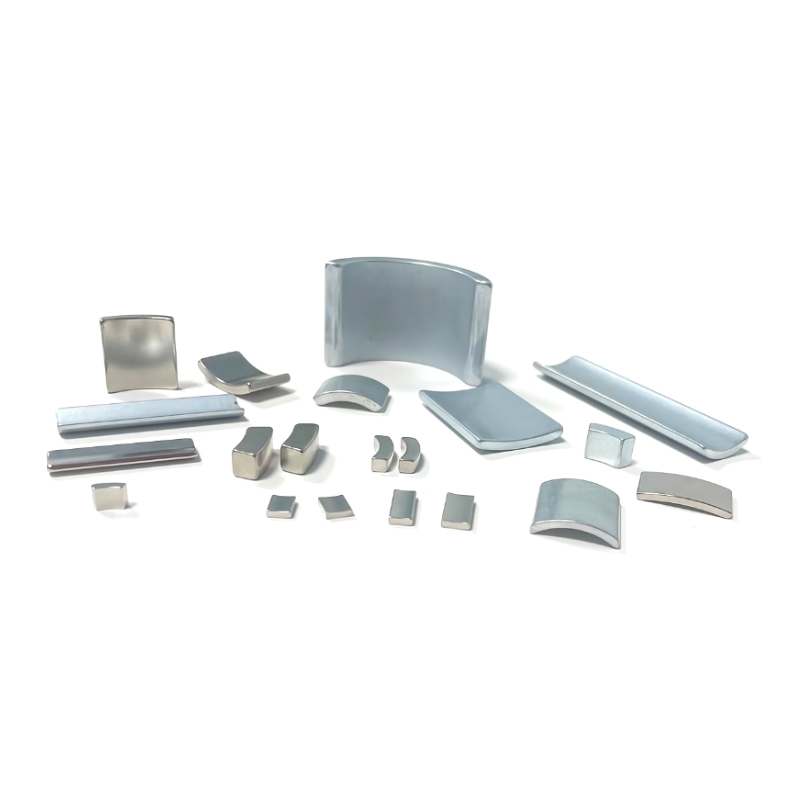
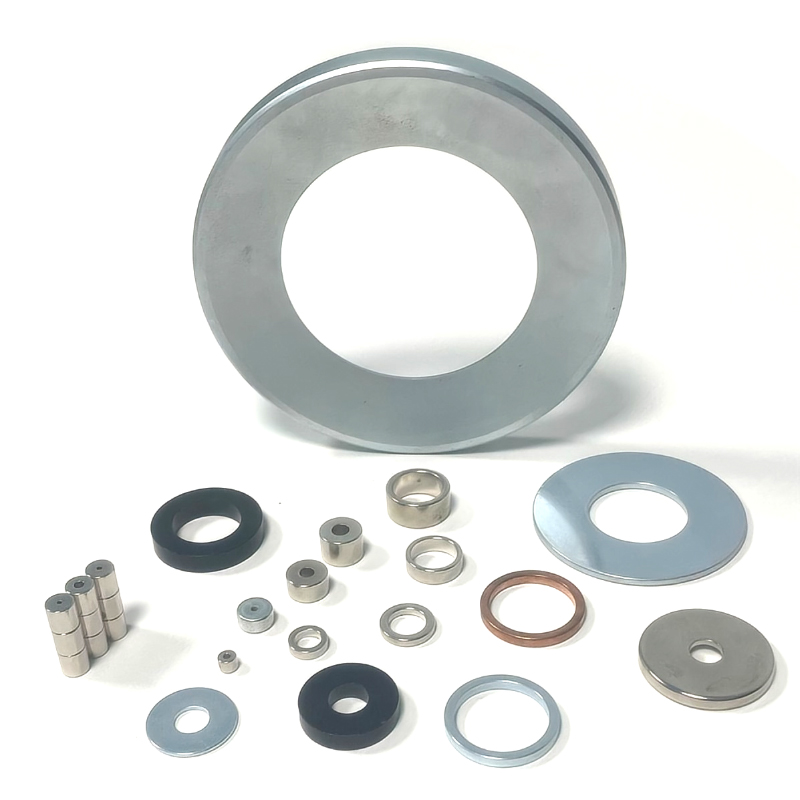
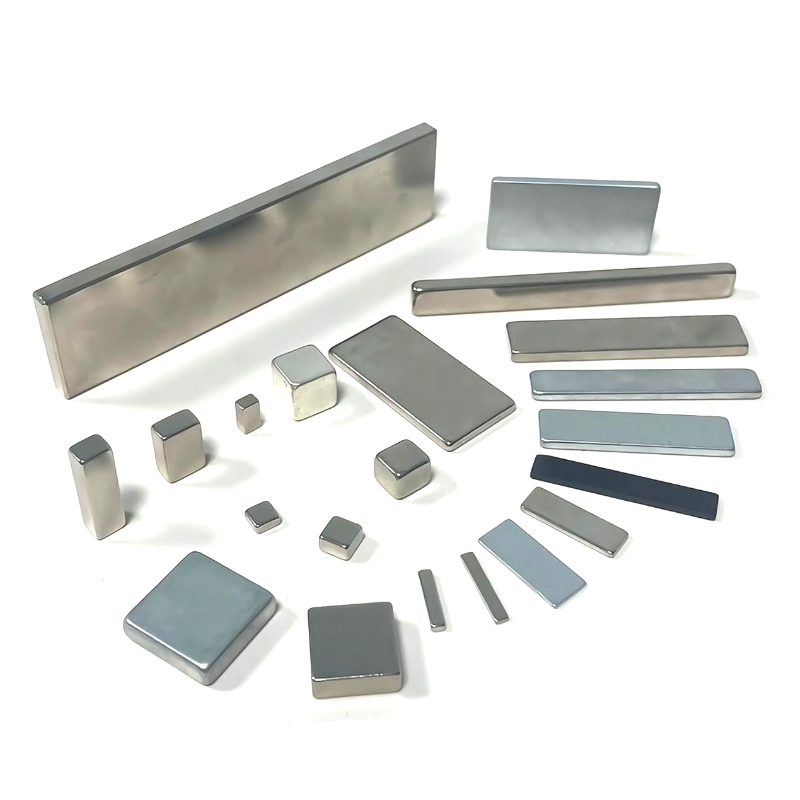
NdFeB magnets are manufactured in a range of standard and custom geometries to match the magnetic circuit requirements of different motor and device designs. The isometric diagram below illustrates four of the most common shape categories produced for motor and industrial applications: disc, block, arc segment, and multi-pole ring magnets, each suited to a different rotor or assembly configuration.
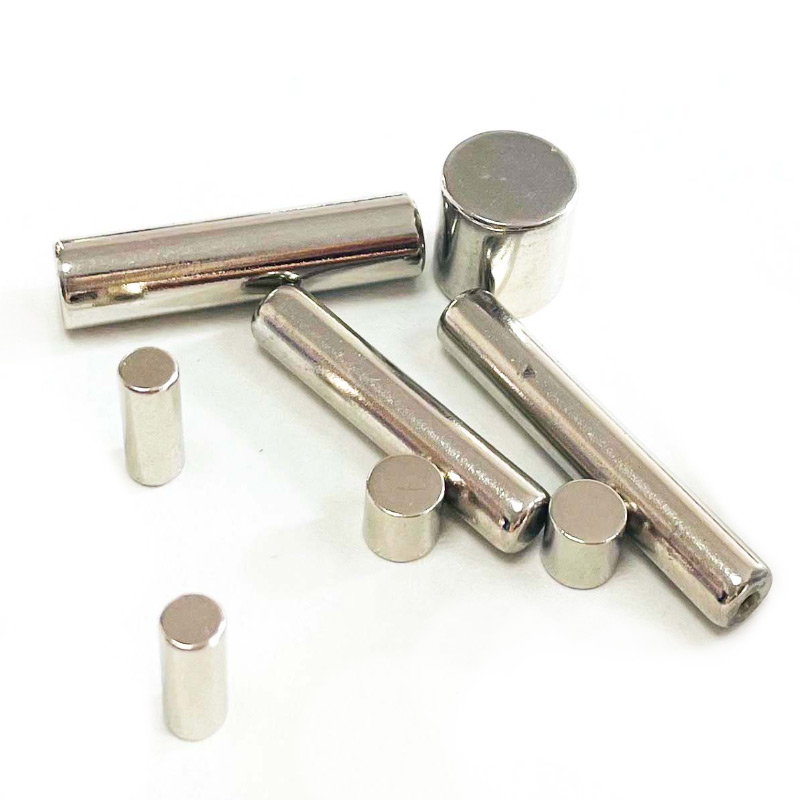
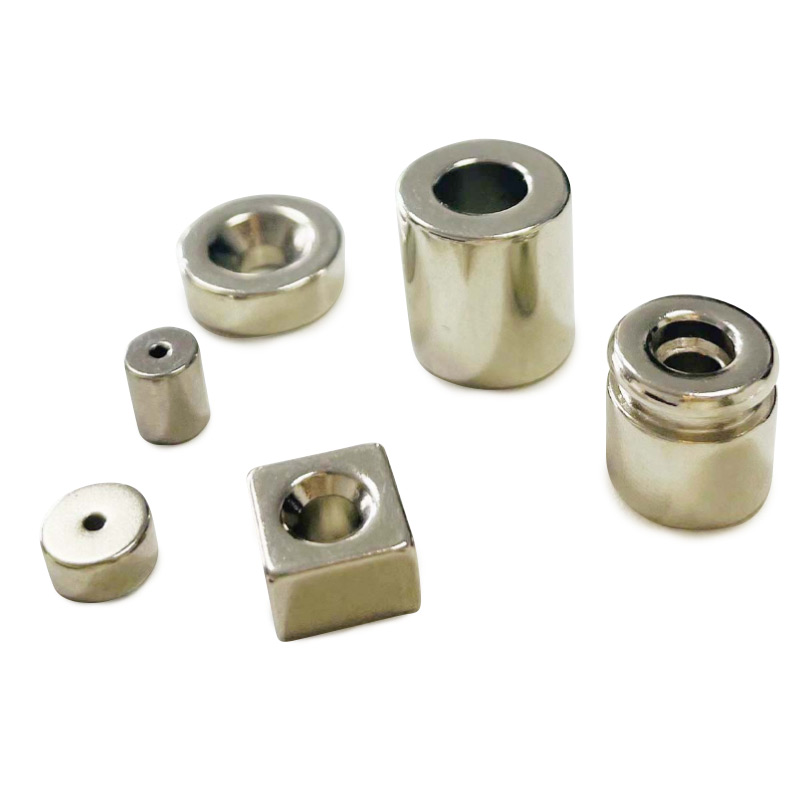
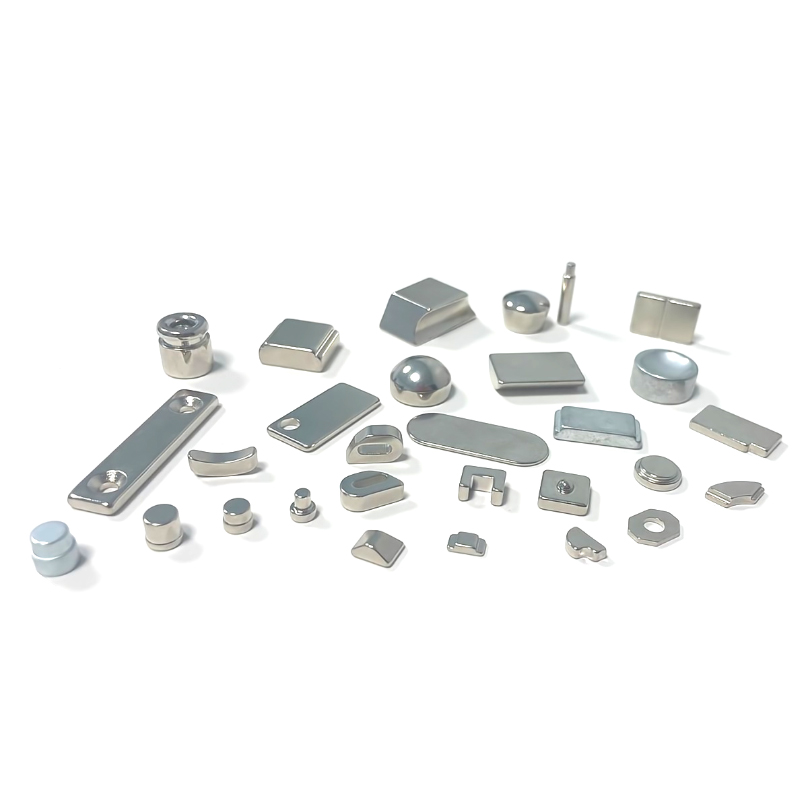
Disc magnets are commonly used in sensors, small actuators, and compact motor applications where a simple axial or radial field is sufficient for the design. Block magnets are widely applied in linear motors and certain BLDC motor rotor configurations, since their flat faces allow straightforward assembly onto a flat rotor or stator surface. Arc segment magnets, shaped to follow the curvature of a rotor, are especially common in surface-mounted permanent magnet motors and hub motors, since the curved profile maintains a consistent air gap around the rotor circumference. Multi-pole ring magnets, magnetized with alternating poles around a single ring rather than assembled from separate segments, are frequently used in small precision motors and sensor applications where multiple poles are needed within a compact, single-piece component. Producing these shapes to the tight dimensional and magnetization accuracy that motor assembly requires depends on precision grinding and, for ring magnets, careful multi-pole magnetizing fixture design, both of which are part of the custom shape capability that a magnet manufacturer needs to support diverse motor architectures.
NdFeB magnets lose a portion of their remanence, the measure of magnetic flux density, as temperature rises, and this loss is generally reversible up to a certain point, after which continued heating or an opposing field can cause irreversible partial demagnetization. Magnet material data commonly referenced in permanent magnet engineering guides indicates that standard NdFeB grades lose remanence at a rate of roughly 0.11 to 0.13 percent per degree Celsius, while intrinsic coercivity typically declines at a steeper rate of approximately 0.55 to 0.65 percent per degree Celsius depending on the specific grade and additive content. This is precisely why coercivity, rather than remanence alone, is the property that determines whether a magnet will survive a motor's actual operating temperature without permanent performance loss. The line chart below presents an illustrative demagnetization trend comparing a standard grade against a high-temperature SH grade as ambient operating temperature increases, based on the general behavior described in permanent magnet technical literature.
The chart shows both grades losing some magnetic retention as temperature increases, which is expected behavior for any NdFeB material since higher temperature always reduces coercivity to some degree. The standard grade line drops noticeably faster past 90 degrees Celsius, reflecting its lower intrinsic coercivity and narrower demagnetization margin under thermal and load stress typical of continuously running motors. The SH grade line remains comparatively flatter through 150 degrees Celsius, illustrating why this and higher grade series are specified for EV traction motors, servo motors, and industrial equipment that regularly operates in this temperature range. This difference in behavior is the underlying reason that a NdFeb Magnets manufacturer serving motor customers needs to match grade selection to the actual thermal profile measured or estimated for the finished assembly, rather than defaulting to a single grade across all product lines. Motor designers working with a magnetic material supplier typically request demagnetization curve data specific to the grade and working point of their design so that the selected magnet retains adequate performance margin throughout the product's expected service life.
NdFeB magnets are prone to oxidation because of their high iron content, so a protective surface coating is standard practice for nearly all commercial NdFeB products, particularly those used in motors exposed to humidity, vibration, or chemical contact. Nickel-copper-nickel plating is one of the most widely used coating systems because it combines good corrosion resistance with mechanical durability, making it suitable for motor rotor assemblies that experience friction and handling during production. Epoxy coatings provide an alternative that offers strong resistance to certain chemical environments and can be a preferred choice for magnets used in humid or corrosive industrial settings, though the coating thickness must be accounted for in the mechanical clearance of the motor assembly. Other coating systems, including zinc plating and phosphate treatments, are used in specific applications where cost, weight, or compatibility with particular assembly adhesives is a priority. Selecting the correct coating is closely tied to the operating environment of the finished product, and a magnet manufacturer with coating process control in-house can typically advise on the combination of grade and coating best suited to a specific motor housing environment.
| Coating Type | Corrosion Resistance | Typical Application |
|---|---|---|
| Ni-Cu-Ni | Good | Motors, general industrial use |
| Epoxy | Very good in humid or chemical settings | Outdoor and industrial equipment |
| Zinc | Moderate | Lower cost general applications |
| Phosphate | Moderate | Assemblies using specific adhesive bonding |
High-temperature NdFeB motor magnets are used across a wide range of industries wherever a compact, high-efficiency motor needs to maintain performance under continuous thermal load. New energy vehicle traction motors, hub motors, and hybrid vehicle motors represent one of the largest and fastest-growing categories of demand, since EV motor rotors routinely operate at elevated temperatures under sustained torque. Industrial automation applications, including servo motors, PMSM and BLDC motors, robotic joint motors, and magnetic separation equipment, also depend heavily on stable high-temperature magnetic performance for repeatable positioning accuracy. Home appliance and consumer electronics motors, such as compressor motors and energy-efficient fan motors, along with medical device micro-motors and energy sector equipment like solar pump motors and elevator traction machines, round out the major application categories. The donut chart below presents an illustrative breakdown of these application categories based on commonly referenced industry groupings for permanent magnet motor demand.
New energy vehicle motors represent the largest application share in this illustrative breakdown because EV traction motors and hub motors require magnets that combine high energy density with strong resistance to demagnetization under sustained thermal and mechanical stress. Industrial automation follows closely, reflecting the steady growth of servo motors, BLDC motors, and robotic joint motors across factory automation, where precise, repeatable torque output depends on consistent magnetic performance over long duty cycles. Home appliance motors represent a stable, high-volume application category, particularly for compressor motors and energy-efficient fans where magnet cost and manufacturing consistency both matter at scale. Medical device motors, while a smaller share by volume, often require tighter dimensional tolerances and specialized shapes, such as those used in dental implant motors and precision surgical instruments. As a NdFeB magnets supplier serving multiple sectors, Ningbo Tujin Magnetic Industry Co., Ltd. has developed process capability across each of these categories, supplying magnet solutions for motor customers as well as speaker, sensor, and wind power applications that rely on similar high-performance magnetic material.
Choosing between a standard grade and a high-temperature grade NdFeB magnet involves balancing several performance factors rather than optimizing for a single metric such as maximum energy product alone. The radar chart below compares standard grade and high-temperature grade material across five factors commonly evaluated during motor magnet selection, illustrating the general tradeoffs a design engineer weighs when specifying magnet material for a new motor program.
The comparison shows standard grade magnets scoring somewhat higher on raw energy product and cost efficiency, since these grades generally offer stronger room-temperature magnetic output for a given material cost. High-temperature grade magnets score noticeably higher on thermal stability and demagnetization resistance, which reflects their additive composition specifically engineered to preserve coercivity as operating temperature rises. Machinability tends to be broadly similar between grade families, since both are sintered NdFeB materials machined using comparable grinding and cutting processes, though very high coercivity grades can be marginally more brittle depending on additive content. This pattern explains why motor designers do not default to the highest available grade across every application, since standard grade material remains a reasonable and cost-efficient choice for motors that operate at moderate, well-controlled temperatures. For continuously loaded motors such as EV traction units or industrial servo motors running near their thermal limits, the improved thermal stability and demagnetization resistance of a high-temperature grade generally outweighs the modest reduction in room-temperature energy product.
Different motor architectures rely on different magnet geometries depending on how the rotor is constructed and how the magnetic circuit needs to be shaped around it. Surface-mounted permanent magnet motors typically use arc segment magnets curved to match the rotor diameter, while interior permanent magnet motors more often use block magnets inserted into slots machined into the rotor core. Small precision motors and sensor applications frequently rely on disc or multi-pole ring magnets, since these shapes suit compact, single-piece rotor designs. The horizontal bar chart below presents an illustrative view of which magnet shape category tends to see the most demand across several common motor types, based on general industry design conventions rather than a single proprietary dataset.
EV traction motors show strong demand for arc segment magnets because the curved shape follows the rotor circumference closely, maintaining a uniform air gap that supports efficient torque generation at high rotational speeds. Servo and BLDC motors frequently use block magnets inserted into rotor slots, since this configuration is well suited to interior permanent magnet designs that prioritize mechanical robustness and manufacturing repeatability. Compressor motors often use a mix of arc and block shapes depending on the specific rotor design chosen by the appliance manufacturer, reflecting the wide variety of compressor motor architectures in use across the home appliance sector. Precision sensor motors and medical micro-motors lean toward disc, ring, and rod geometries because these compact shapes fit small, space-constrained assemblies where a simple, single-piece magnet simplifies both manufacturing and installation. Recognizing these general shape tendencies helps engineering teams communicate requirements more efficiently with a magnet supplier during the early design stage, reducing the number of design iterations needed before a final magnet specification is confirmed.
Consistent magnetic output across a production batch depends on testing at multiple stages of manufacturing, from raw powder characterization through final magnetized product inspection. Key properties measured typically include remanence, coercivity, and maximum energy product, along with dimensional checks to confirm the finished magnet meets the tolerances required for motor assembly. Batch-to-batch consistency is particularly important for motor customers, since even small variations in magnetic output across magnets used in the same rotor assembly can create torque ripple or uneven performance across a production run of finished motors. The gauge chart below illustrates the general level of batch consistency that a well-controlled sintered NdFeB manufacturing process is expected to achieve relative to a stated target specification.
A needle positioned toward the high end of this gauge reflects a manufacturing process where pressing, sintering, and grinding parameters are tightly controlled, allowing successive production batches to fall within a narrow range of the target magnetic specification. Reaching this level of consistency generally requires calibrated testing equipment, such as a hysteresisgraph for measuring the full demagnetization curve, along with systematic sampling across each production batch rather than testing only a small number of pieces. Dimensional consistency is equally important for motor assembly, since even magnets with correct magnetic properties can cause assembly issues or uneven air gaps if ground to inconsistent thickness or diameter. Manufacturers supplying motor customers with strict quality requirements, such as automotive or medical device programs, typically maintain detailed testing records for each batch so that any deviation can be traced back to a specific stage of the production process. This combination of magnetic testing, dimensional verification, and batch traceability is what allows a magnet manufacturer to support demanding motor programs where consistent performance across thousands or millions of units is required.
Sintered NdFeB magnets are produced through a multi-stage process that begins with alloying raw rare earth and iron materials, followed by strip casting, hydrogen decrepitation, and fine milling to produce a magnetic powder with the correct particle size for pressing. The powder is then pressed under an aligning magnetic field to orient the magnetic domains, sintered at high temperature to achieve full density, and heat treated to optimize the final magnetic properties before being ground to precise dimensions. After grinding, magnets undergo surface coating, magnetic property testing, and in many cases final magnetization, depending on whether the customer requires the part supplied premagnetized or unmagnetized for assembly reasons. Each of these stages introduces variables that affect final magnetic output and dimensional accuracy, which is why consistent process control across pressing, sintering, and grinding is essential for a manufacturer supplying motor customers who require tight, repeatable tolerances across large production volumes. A rare earth magnets factory with integrated process control across these stages is generally better positioned to hold consistent magnetic output batch to batch compared with an operation that outsources key steps such as grinding or coating to third parties.
Bringing a new motor design from initial prototype magnets through validated mass production typically involves several distinct stages, and each stage carries its own risk of introducing dimensional or magnetic property drift if not carefully managed. Prototype samples are generally produced first to confirm fit, magnetic performance, and assembly compatibility, followed by a pilot batch that validates the production tooling and process parameters at a small scale before committing to full volume manufacturing. Once the pilot batch is approved, the transition to mass production requires the same pressing, sintering, grinding, coating, and testing parameters to be reproduced consistently across much larger batch sizes, which is where a manufacturer's internal process discipline becomes most visible. Magnet suppliers with streamlined internal workflows connecting design, tooling, and production are generally able to move through these stages with fewer delays, since design changes identified during prototyping can be implemented directly without renegotiating separate contracts with external vendors at each stage. This is particularly relevant for customers developing time-sensitive motor programs, such as new EV platforms or appliance product launches, where a magnet supplier's ability to move efficiently from sample approval to full-scale supply can directly affect the customer's own production timeline. A magnet manufacturer that documents lessons learned during each prototype and pilot stage, applying that knowledge consistently at mass production scale, is generally better positioned to deliver stable, repeatable quality across the full life of a motor program rather than only during initial sample runs.
Selecting a magnet supplier for a motor program is a decision that affects long-term product reliability, since magnets are typically a fixed component that cannot easily be swapped once a motor design has been validated and moved into production. Buyers evaluating a potential NdFeB magnets factory generally benefit from reviewing the practical factors below before committing to a supplier for a new or existing motor platform.
Experience with a specific motor type matters because the demagnetization risk profile differs meaningfully between, for example, a low-speed appliance fan motor and a high-torque EV hub motor, and a supplier familiar with the relevant operating conditions can recommend grade and shape choices with fewer design iterations. Clear grade documentation allows a customer's engineering team to independently verify that a proposed magnet will meet the thermal and demagnetization margin required for their application rather than relying solely on the supplier's general assurances. Custom shape capability is particularly relevant for motor programs with non-standard rotor geometries, since a supplier limited to a narrow range of standard shapes may not be able to support a design that requires an arc segment or multi-pole ring configuration. Coating selection support ensures the magnet's corrosion protection matches the actual environment the motor will operate in, whether that is a sealed indoor appliance or outdoor industrial equipment exposed to humidity. Finally, responsive design support and predictable lead times reduce the risk of production delays during the transition from prototype validation to full-scale motor manufacturing, which is often the stage where magnet-related issues are most costly to resolve.
Ningbo Tujin Magnetic Industry Co., Ltd. specializes in the manufacturing and sales of high-performance NdFeB magnets, with years of expertise in magnetic materials focused on high-temperature-resistant motor magnets and customized magnetic solutions built around precision and stability. The company's high-temperature motor magnets are designed to meet demanding thermal stability requirements and maintain magnetic performance across a working range of approximately negative 40 degrees Celsius to 200 degrees Celsius or higher, supporting applications across new energy vehicle traction and hub motors, hybrid vehicle motors, servo motors, PMSM and BLDC motors, robotic joint motors, magnetic separation equipment, home appliance compressor and fan motors, dental implant and medical instrument micro-motors, and energy sector equipment including solar pump motors, turbines, and elevator traction machines. Beyond standard grades, Ningbo Tujin Magnetic Industry supports complex and precision custom shapes, including disc, block, arc segment, multi-pole magnetized ring, and rod geometries, along with advanced coatings such as Ni-Cu-Ni and epoxy systems that enhance oxidation resistance and extend service life. As a trusted long-term partner for leading companies across multiple industries, the company combines streamlined design-to-mass-production processes with industry-wide application experience spanning motors, audio speaker magnets, sensors, and wind power equipment, positioning it as a dependable resource for customers seeking a custom NdFeB magnets partner rather than a single-transaction supplier.
High-temperature grade magnets, such as SH, UH, or EH series, contain additives that raise intrinsic coercivity, allowing them to resist demagnetization at higher operating temperatures compared with standard N-series grades.
Common shapes include disc, block, arc segment, multi-pole magnetized ring, and rod geometries, and shapes can generally be customized further to match a specific rotor or magnetic circuit design.
NdFeB magnets contain a high proportion of iron, which is prone to oxidation, so coatings such as Ni-Cu-Ni or epoxy are applied to protect the magnet from corrosion during long-term use.
Common industries include new energy vehicles, industrial automation, home appliances, medical devices, and energy or heavy machinery equipment that require stable motor performance under thermal load.
Grade selection should be based on the motor's actual expected operating temperature and demagnetization margin, which is best determined by working directly with a magnet manufacturer that can review the application's thermal profile.

Having a blueprint in mind, working hard and forging ahead
 No.107 Yunshan Industry Park, Sanqishi Town, Yuyao, Ningbo, Zhejiang 315412, China
 +86-18858010843
 sales@tujinmagnet.com
Copyright ? Ningbo Tujin Magnetic Industry Co., Ltd. All Rights Reserved. Custom Rare Earth Magnets Factory