-
sales@tujinmagnet.com
-
+86-18858010843

Conclusion: NdFeB bar magnets are significantly stronger than ferrite magnets — typically 5 to 10 times more powerful by volume, with a maximum energy product (BHmax) of 30-52 MGOe compared to ferrite's 3-5 MGOe. For applications requiring high magnetic force in compact spaces, such as NdFeB bar magnet strength comparison consistently shows neodymium outperforms ferrite. However, ferrite magnets maintain advantages in cost-sensitive applications and environments with moderate temperatures. When sourcing from a custom NdFeB bar magnets supplier, understanding grade specifications (N35 to N52) and high temperature NdFeB magnet grade options (SH, UH, EH) ensures optimal selection for your application.
Content
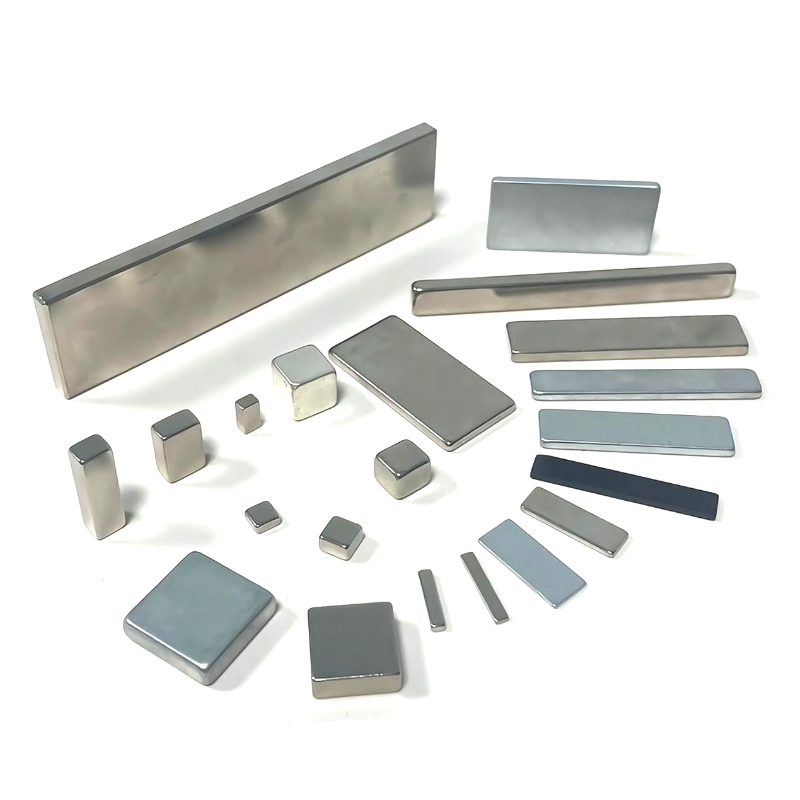
The maximum energy product (BHmax) measures a magnet's magnetic flux density and resistance to demagnetization. NdFeB magnets achieve 30-52 MGOe (239-414 kJ/m³), while ferrite magnets typically range from 3-5 MGOe (24-40 kJ/m³). This difference explains why a custom NdFeB bar magnet of the same size as a ferrite bar can hold several times more weight.
Maximum Energy Product (BHmax) Comparison
NdFeB magnets deliver 5-10 times higher energy density than ferrite magnets
This dramatic difference makes NdFeB bar magnet strength comparison a critical consideration for engineers designing compact magnetic assemblies.
While NdFeB magnets are stronger at room temperature, ferrite magnets maintain performance better at elevated temperatures. Standard N-grade NdFeB operates up to 80°C, while ferrite (Y35) functions up to 250°C. For high-temperature applications, selecting the appropriate high temperature NdFeB magnet grade is essential.
| Material / Grade | Max Operating Temp (°C) | Curie Temp (°C) | Irreversible Loss at Max Temp |
|---|---|---|---|
| Ferrite Y35 | 250 | 450 | ~2-5% |
| NdFeB N (e.g., N42) | 80 | 310 | ~5-10% |
| NdFeB H (e.g., N42H) | 120 | 320 | ~3-6% |
| NdFeB SH (e.g., N38SH) | 150 | 340 | ~2-5% |
| NdFeB UH (e.g., N35UH) | 180 | 350 | ~2-4% |
| NdFeB EH (e.g., N33EH) | 200 | 360 | ~2-4% |
A custom NdFeB bar magnets supplier can provide high-temperature grades (SH, UH, EH) that operate reliably at 150-200°C, bridging the gap with ferrite performance while maintaining superior magnetic strength.
Magnetic Strength Retention at 150°C (Normalized to 25°C)
High-temperature grades (EH, UH, SH) retain significantly more magnetic strength at elevated temperatures
Coercivity (Hcj) measures a magnet's resistance to demagnetization by opposing magnetic fields. Ferrite magnets have high coercivity (200-300 kA/m) and are difficult to demagnetize. Standard NdFeB N-grade has lower coercivity (860-1,000 kA/m), but high temperature NdFeB magnet grade options (SH, UH, EH) offer coercivity up to 2,390 kA/m, exceeding ferrite values.
For applications involving strong opposing magnetic fields or high vibration environments, a custom NdFeB bar magnets supplier can recommend appropriate coercivity grades to prevent performance degradation.
Ferrite magnets are naturally corrosion-resistant due to their ceramic composition. NdFeB magnets contain iron and are susceptible to oxidation in humid environments. However, quality custom NdFeB bar magnets are protected with coatings that provide excellent corrosion resistance:
With proper coating selection, NdFeB magnets achieve comparable corrosion resistance to ferrite in most indoor and protected outdoor environments.
Salt Spray Test Results (Hours to First Red Rust)
Proper coating selection makes NdFeB suitable for most environments
The NdFeB bar magnet strength comparison favors neodymium for most performance-driven applications. However, material selection should consider the full application requirements:
No.107 Yunshan Industry Park, Sanqishi Town, Yuyao, Ningbo, Zhejiang 315412, China
+86-18858010843
sales@tujinmagnet.com
Copyright ? Ningbo Tujin Magnetic Industry Co., Ltd. All Rights Reserved. Custom Rare Earth Magnets Factory