-

sales@tujinmagnet.com
-

+86-18858010843

Content
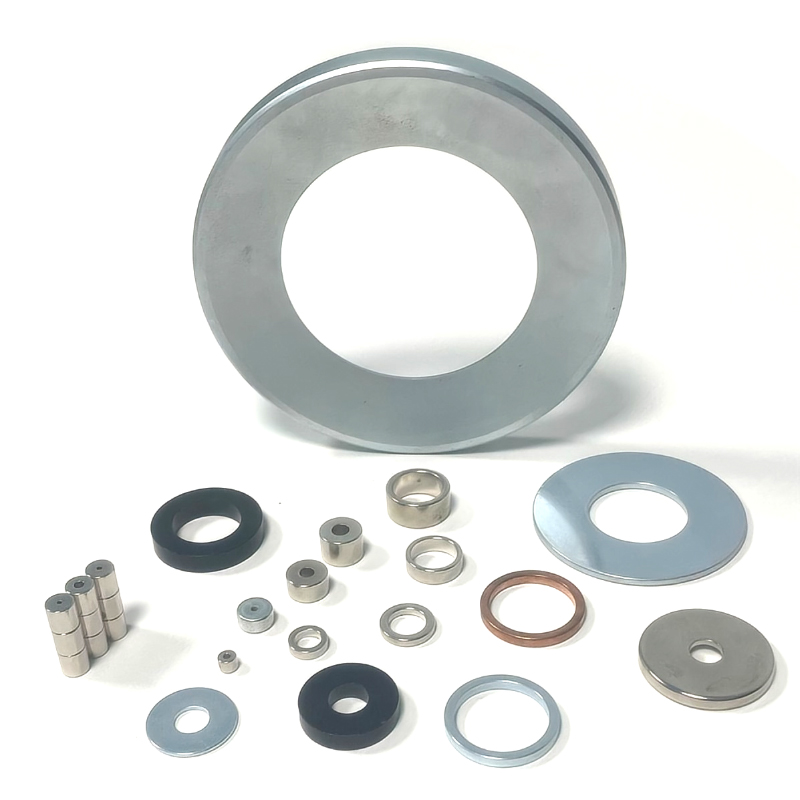
The principal advantages of neodymium magnet rings are exceptional magnetic strength relative to size, a through-hole geometry that enables axial shaft mounting and through-bore applications, and the ability to be magnetized in multiple pole configurations — including axially, diametrically, and multi-pole radially — making them uniquely versatile among permanent magnet geometries. Neodymium (NdFeB) ring magnets achieve energy products of 35–55 MGOe (280–440 kJ/m³), which is five to ten times greater than ferrite magnets of equivalent volume. This means a neodymium ring magnet can deliver the same magnetic force as a much larger ferrite ring while occupying a fraction of the space and weight — a decisive advantage in compact motors, sensors, magnetic couplings, and medical devices where dimensional constraints are critical.
The defining advantage of neodymium ring magnets over all other permanent magnet materials is their energy density — the amount of magnetic energy stored per unit volume of magnet material. This property, quantified by the maximum energy product (BHmax), directly determines how much work the magnet can perform in attracting, repelling, or coupling with other magnetic elements.
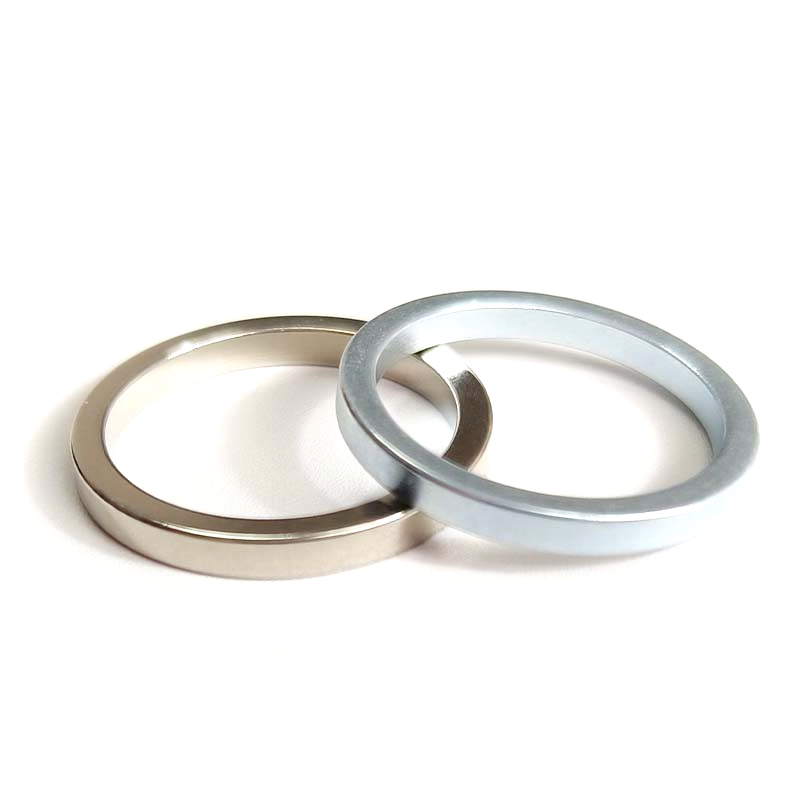
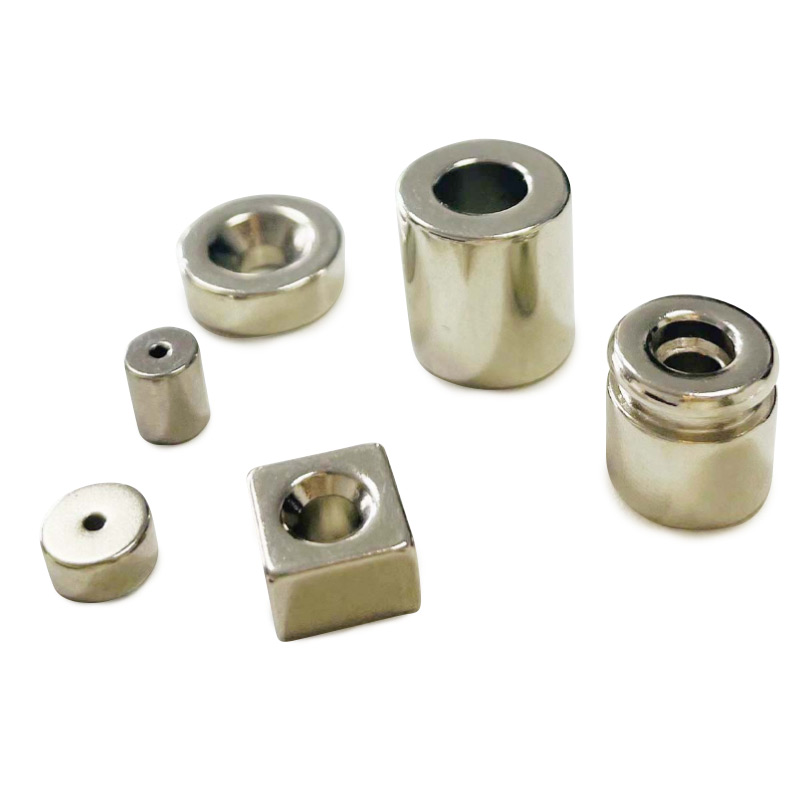
The annular (ring) geometry of these magnets provides functional advantages that solid disc or block magnets cannot offer. The central bore is not merely a material saving — it is a design feature that enables entire categories of application.
The through-bore allows a neodymium ring magnet to be mounted directly onto a rotating shaft, fixed axle, or cylindrical housing without requiring an adapter plate or bracket. In rotary position sensors, encoders, and electric motors, this direct shaft mounting eliminates mechanical backlash from intermediate coupling components and reduces the axial length of the assembly. The magnet rotates concentrically with the shaft with inherent precision, which is critical for applications requiring angular accuracy of ±0.1° or better.
In magnetic couplings, bearings, and medical catheter systems, the central bore allows fluid, shafts, wires, or optical fibers to pass through the center of the magnetic assembly while the annular magnet provides the surrounding magnetic field. This geometry is impossible to replicate with solid magnets and enables designs such as magnetically coupled pumps (where the magnet ring couples torque across a hermetically sealed barrier, eliminating the shaft seal that would otherwise be a leakage risk) and magnetic resonance gradient coils.
When magnetized axially (poles on the flat faces) or diametrically (poles on opposite sides of the ring), neodymium ring magnets produce field distributions with inherent circular symmetry around the bore axis. This symmetry is mechanically advantageous in rotating systems — a diametrically magnetized ring magnet on a rotating shaft produces a sinusoidally varying field at any fixed point adjacent to the shaft, which is the waveform required by Hall-effect rotary position sensors and resolver encoder systems.
One of the most practically important advantages of neodymium ring magnets is the range of magnetization directions and pole configurations available within the same physical geometry. This flexibility allows the same ring form factor to be optimized for entirely different magnetic circuit requirements.
| Magnetization Type | Pole Location | Field Pattern | Key Applications |
|---|---|---|---|
| Axial | Top and bottom flat faces | Field projects axially above and below ring plane | Magnetic couplings, axial-field motors, linear actuators |
| Diametric (2-pole) | Opposite sides of outer diameter | Sinusoidal field rotating with shaft | Rotary encoders, position sensors, angle detectors |
| Radial (inner/outer surface) | Inner bore surface (N) and outer surface (S), or reverse | Radially outward or inward field across entire circumference | Brushless DC motors, generators, magnetic bearings |
| Multi-pole radial (4, 6, 8+ poles) | Alternating N/S poles around circumference | Multiple alternating field reversals per revolution | Servo motors, high-resolution encoders, stepping motors |
Neodymium ring magnets are the preferred permanent magnet format for the rotor assemblies of brushless DC motors, permanent magnet synchronous motors (PMSM), and axial-flux generators — the motor and generator types that power electric vehicles, industrial servo drives, wind turbines, and power tool motors.
In sensor and encoder applications, the neodymium ring magnet's combination of high field strength, precise geometry, and flexible magnetization patterns makes it the preferred target magnet for a wide range of position, speed, and angle measurement systems.
The combination of high field strength, compact size, and ring geometry makes neodymium ring magnets essential components in several categories of medical device and scientific instrument where performance per unit volume is critical.
| Property | Neodymium (NdFeB) | Ferrite (Ceramic) | Samarium Cobalt (SmCo) | Alnico |
|---|---|---|---|---|
| Max energy product (MGOe) | 35–55 | 3.5–5 | 16–32 | 1.5–5.5 |
| Remanence Br (Tesla) | 1.08–1.52 | 0.35–0.43 | 0.85–1.15 | 0.6–1.35 |
| Max operating temp (°C) | 80–200 (grade dependent) | 250–300 | 250–350 | 450–550 |
| Corrosion resistance | Poor — coating required | Excellent | Good | Good |
| Relative cost | Medium | Lowest | Highest | Medium–High |
| Best advantage | Highest field strength per volume | Low cost, corrosion resistance | High temp + high strength | Highest temp resistance |
Understanding where neodymium ring magnets are not the optimal choice is as important as knowing their advantages. Two key limitations should be factored into material selection decisions.
Having a blueprint in mind, working hard and forging ahead
 No.107 Yunshan Industry Park, Sanqishi Town, Yuyao, Ningbo, Zhejiang 315412, China
 +86-18858010843
 sales@tujinmagnet.com
Copyright ? Ningbo Tujin Magnetic Industry Co., Ltd. All Rights Reserved. Custom Rare Earth Magnets Factory