-
sales@tujinmagnet.com
-
+86-18858010843

Wedge Shaped Neodymium Magnets in Motors and Generators: A Direct Answer
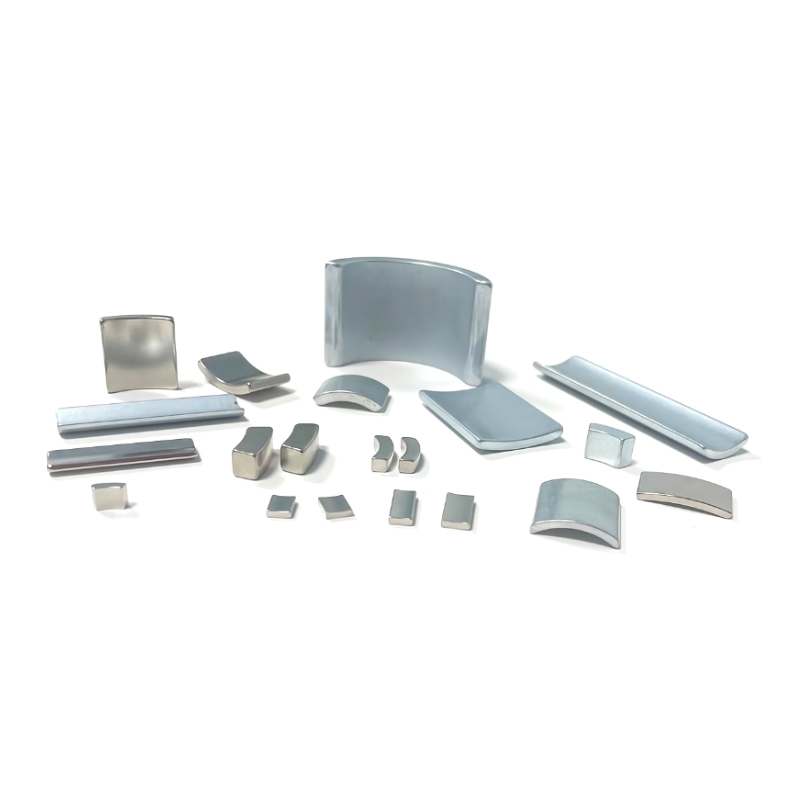
Wedge shaped neodymium magnets are primarily used in the rotor assemblies of permanent magnet motors and generators to maximize the magnetic flux density within constrained circular geometries. Their tapered, trapezoidal cross-section allows them to fit precisely into the segmented ring structure of a rotor or stator, eliminating dead space and enabling a smooth, continuous magnetic field around the circumference of the machine.
In practical terms, this geometry enables motors to produce 15–30% higher torque density compared to rectangular magnet arrangements of the same total magnet mass. For generator designers, wedge segments ensure a more uniform air gap field distribution, directly reducing harmonic distortion in the output waveform. These characteristics make wedge shaped neodymium magnets for motor and generator applications a critical engineering choice across industries from electric vehicles to wind turbines.
Content
In any permanent magnet motor or generator, the rotor is fundamentally a cylindrical component. When designers attempt to tile flat rectangular magnets onto a curved surface, they introduce angular gaps at the edges. These gaps represent wasted magnetic flux and uneven field distribution — both of which degrade performance.
Wedge shaped (also called arc segment or sector magnets) neodymium magnets solve this problem by tapering from a wider outer face to a narrower inner face (or vice versa), matching the natural curvature of the rotor. The result is:
Approximate relative improvement compared to equivalent rectangular neodymium magnet configurations in typical PM motor designs.
EV traction motors demand the highest possible torque per unit weight. Interior permanent magnet (IPM) motors used in most modern EVs rely on precisely dimensioned wedge or V-shaped neodymium magnet inserts within rotor laminations. A typical EV drive motor uses 12–24 wedge magnet segments per rotor, each ground to tolerances within ±0.05 mm to ensure rotational balance at speeds exceeding 12,000 RPM.
Direct-drive permanent magnet generators for wind turbines often feature large-diameter rotors with dozens or hundreds of pole pairs. Wedge-shaped neodymium arc magnets are surface-mounted or embedded in these rotors. A 3 MW direct-drive wind turbine generator may use over 800 individual wedge magnet segments, each contributing to the consistent low-speed, high-torque output characteristic of direct-drive designs.
High-precision CNC machinery and robotic arms use servo motors where smooth, ripple-free torque is essential. Wedge magnets reduce the torque ripple caused by discrete magnetic poles, enabling positioning accuracy in the arc-second range. This is why custom wedge neodymium magnets supplier partnerships are common in precision machinery manufacturing.
Permanent magnet motors used in hybrid-electric aircraft and electric ship propulsion systems operate under strict weight and size constraints. Wedge neodymium magnets allow engineers to maximize power density, with some aerospace PM motors achieving power densities above 5 kW/kg — a figure that is not achievable with standard rectangular magnet arrangements.
Small-scale hydroelectric generators, tidal current generators, and micro-wind turbines all benefit from the efficient packing and smooth field distribution that wedge-shaped neodymium magnets provide. These generators often run at variable speeds, and a uniform flux profile helps stabilize output voltage across a wide RPM range.
Selecting the right grade and geometry for wedge neodymium magnets requires balancing magnetic strength, thermal performance, and corrosion resistance. The table below summarizes the most widely used grades for motor and generator applications:
| Grade | Remanence Br (T) | Max Operating Temp (°C) | Coercivity (kA/m) | Typical Application |
| N35 | 1.17–1.22 | 80 | ≥955 | Low-heat consumer motors |
| N42SH | 1.29–1.33 | 150 | ≥1592 | Automotive EV motors |
| N48H | 1.38–1.42 | 120 | ≥1114 | High-torque servo motors |
| N38UH | 1.24–1.28 | 180 | ≥1990 | Wind turbine generators |
| N35EH | 1.17–1.22 | 200 | ≥2388 | Aerospace / high-temperature |
| Common Neodymium Magnet Grades for Motor and Generator Wedge Applications | ||||
The suffix letters (H, SH, UH, EH) indicate elevated coercivity for thermal stability. For motors operating in environments above 120°C — such as under-hood automotive applications — grades N38UH or N35EH are typically specified to prevent irreversible demagnetization.
When specifying wedge shaped neodymium magnets for motor designs, engineers must define several geometric and magnetic parameters precisely. These include:
The inner radius matches the rotor shaft diameter (or the lamination bore), while the outer radius aligns with the air gap boundary. Even a 0.1 mm deviation in radius can alter the air gap length, which affects the motor's back-EMF constant and efficiency by a measurable margin.
The arc angle determines how much of each magnetic pole is covered by the magnet. A pole coverage ratio of 0.7 to 0.85 (70–85% of the pole pitch) is typical for surface-mounted PM motors. Higher coverage increases flux but can amplify cogging torque if not balanced with slot design.
Wedge magnets may be magnetized radially (perpendicular to the arc face), parallel (uniform direction), or in more complex Halbach array patterns. Radial magnetization is the most common for surface-mounted rotors and delivers a near-sinusoidal flux waveform in the air gap.
Neodymium magnets are susceptible to corrosion. For motor applications, the standard coating options are:
The relationship between magnet dimensional accuracy and motor performance is direct. In high-speed motors operating above 6,000 RPM, an imbalanced rotor resulting from magnets of inconsistent thickness can induce vibration, bearing wear, and noise. A tolerance of ±0.05 mm on thickness and ±0.1 mm on arc length is a common specification for precision motor applications.
Achieving this level of precision requires diamond wire cutting or CNC grinding after sintering, followed by individual magnet inspection using coordinate measuring machines (CMM). A qualified custom wedge neodymium magnets supplier will offer documented dimensional inspection reports (First Article Inspection) and can provide magnetic flux measurement data (Gauss meter readings) traceable to each production batch.
Tighter dimensional tolerances in wedge magnet production correlate with significantly lower rotor vibration at operating speed.
Two principal mounting strategies govern how wedge neodymium magnets are integrated into rotors:
In this arrangement, wedge arc magnets are bonded directly to the outer surface of a cylindrical rotor yoke. This is the simpler configuration and is common in direct-drive generators and low-speed servo motors. The magnets are typically held with structural epoxy adhesive and may be retained by a carbon fiber or stainless steel sleeve at high speeds. SPM rotors can achieve air gap flux densities of 0.85–1.0 T with high-grade neodymium segments.
In IPM motors — the dominant topology in EV drivetrains — wedge-shaped neodymium magnets are embedded within slots or cavities machined into the rotor lamination stack. This protects the magnets from centrifugal forces and enables reluctance torque to supplement magnetic torque, improving efficiency. The V-shaped or multilayer arrangements typical of IPM rotors use pairs of wedge magnets oriented at specific angles, typically 15° to 40° from the rotor tangent, to maximize reluctance saliency.
| Parameter | Surface-Mounted (SPM) | Interior Permanent Magnet (IPM) |
| Max Speed | Up to 6,000 RPM (unsleeveed) | Up to 18,000+ RPM |
| Torque Source | Magnetic torque only | Magnetic + reluctance torque |
| Magnet Protection | Exposed (needs sleeve at high speed) | Fully enclosed in laminations |
| Assembly Complexity | Lower | Higher |
| Power Factor | Moderate | High (above 0.95 achievable) |
| Best Use Case | Direct-drive generators, servo motors | EV traction, aerospace propulsion |
| SPM vs. IPM Configuration Comparison for Wedge Neodymium Magnets | ||
Not all suppliers have the tooling, quality systems, or materials expertise needed to produce precision wedge magnets for demanding motor applications. When evaluating a custom wedge neodymium magnets supplier, consider the following criteria:
No.107 Yunshan Industry Park, Sanqishi Town, Yuyao, Ningbo, Zhejiang 315412, China
+86-18858010843
sales@tujinmagnet.com
Copyright ? Ningbo Tujin Magnetic Industry Co., Ltd. All Rights Reserved. Custom Rare Earth Magnets Factory