-
sales@tujinmagnet.com
-
+86-18858010843

Content
Neodymium magnets, also known as NdFeB magnets, do not pose a danger to the human body during normal handling and use; everyday exposure to their magnetic field, such as in headphones, fasteners, or motor components, is not considered harmful, since field strength diminishes rapidly with distance. The real risk relates almost entirely to accidental ingestion of small magnets, particularly by children, and to mechanical hazards from their strong attractive force, such as pinching or skin injury during handling, rather than the magnetic field itself causing internal harm to adults under normal conditions. This article explains what NdFeB magnets are made of, how the N35 to N52 grading system works, what the available coatings and grades mean for performance, and how custom neodymium magnets are applied across motors, industrial automation, and consumer electronics.
Understanding both the engineering properties and the practical safety considerations of NdFeB magnets helps procurement teams, design engineers, and motor manufacturers select the right grade and shape for their application. The sections below walk through composition, grade comparisons, temperature performance, and real-world sourcing considerations for buyers evaluating a neodymium magnets manufacturer or rare earth magnets factory for custom production.
The magnetic field produced by neodymium magnets in typical consumer or industrial use is not considered harmful to human tissue. Reference safety material consistently notes that the magnetic field strength diminishes rapidly with distance, so normal use in devices such as headphones or magnetic closures does not pose significant health risks to people standing near or handling the finished product.
The primary documented hazards instead relate to physical handling and accidental ingestion. Safety guidance highlights that if two magnets or a magnet and a metal object come together forcefully, they can cause pinching injuries, and that small magnets are easily swallowed, posing a risk of intestinal blockage if multiple magnets are ingested together. This is why finished magnetic products intended for consumer goods are typically engineered into safe assemblies rather than left as loose small components.
A further precaution applies to individuals with implanted medical devices. Reference safety documentation advises keeping strong magnets away from people with pacemakers or other implanted devices, since the magnetic field may interfere with device operation. For most industrial, motor, and engineering applications where magnets are securely mounted inside an assembly, these risks are effectively eliminated through proper product design and housing.
A neodymium magnet, chemically referred to as Nd2Fe14B, is a sintered alloy formed from neodymium, iron, and boron. According to materials engineering references, adjusting the ratio of these elements, along with sintering density and raw material purity, allows manufacturers to tune the magnet's strength and consistency to a specific performance class.
The grade code itself, such as N35 or N52, encodes two distinct pieces of information. The number indicates the maximum energy product (BHmax), measured in Mega-Gauss Oersteds (MGOe), where a higher number means a stronger magnetic field for a given volume. Any letter suffix following the number, such as M, H, SH, UH, EH, or AH, indicates the magnet's coercivity class, which determines its maximum recommended operating temperature rather than its raw strength.
| Suffix | Class Name | Approx. Max Temp (°C) |
|---|---|---|
| None | Standard | 80 |
| M | Medium | 100 |
| H | High | 120 |
| SH | Super High | 150 |
| UH | Ultra High | 180 |
| EH | Extra High | 200 |
| AH | Advanced High | 230 |
Engineers selecting a grade should treat the number and suffix as two separate decisions: the number sets raw field strength, while the suffix sets thermal stability. A magnet such as N42SH balances solid strength with resistance to heat, which explains why mid-range suffix grades are common in motor applications rather than always defaulting to the highest available number grade.
N35 and N52 are two of the most frequently referenced grades, and comparing them illustrates the core trade-off in neodymium magnet selection. Material specification data indicates that N35 has a maximum energy product around 33 to 36 MGOe, while N52 reaches roughly 48 to 51 MGOe, meaning N52 generates significantly more magnetic flux for the same magnet volume.
Despite the strength advantage, higher number grades are not automatically the better choice for every application. Technical comparisons note that N35 magnets typically maintain stable performance up to around 80°C, while standard N52 without a temperature suffix has comparatively lower heat tolerance and a higher risk of demagnetization in hot environments unless an appropriate suffix grade is specified. This is precisely why high-temperature-resistant motor magnets intended for environments such as EV traction motors or industrial servo motors are commonly specified using a number-plus-suffix combination, such as N42SH, rather than a raw high-number grade alone.
This horizontal bar chart compares the approximate maximum energy product across five common neodymium magnet grades, from N35 to N52. The chart shows a steady, near-linear increase in magnetic energy as the grade number rises, confirming that each step up the N-scale delivers a measurable strength gain for the same magnet volume. N52, at the top of the chart, produces close to 48 percent more magnetic flux than N35 for an equivalent size, which is why higher grades allow for smaller and lighter magnet designs in space-constrained applications such as miniature motors or sensors. However, this chart represents room-temperature strength only, and does not capture thermal stability, which is governed separately by the suffix letter. Buyers should treat this strength comparison alongside the temperature suffix table above rather than in isolation, since the highest-strength grade is not always the most reliable choice for hot operating environments. For applications requiring both high strength and elevated temperature resistance, a combination grade such as N48H or N42SH is typically the more balanced engineering choice.
Raw NdFeB material is chemically reactive and prone to oxidation, so finished magnets are virtually always supplied with a protective surface coating. Reference material on neodymium specifications notes that to prevent corrosion, neodymium magnets are commonly coated with materials such as nickel, copper, or epoxy, with nickel-copper-nickel (Ni-Cu-Ni) being a widely used multilayer system for general industrial use.
Coating selection depends on the magnet's operating environment. Zinc coatings offer good adhesion for gluing or taping applications, while nickel-epoxy treatments are generally recommended for magnets exposed to humid or wet conditions, since epoxy provides an additional sealed barrier against moisture ingress. For motor and industrial automation applications operating at elevated temperatures, coating durability under thermal cycling becomes an additional consideration alongside the base material's temperature suffix grade.
This line chart illustrates how demagnetization risk increases with operating temperature for a standard-grade NdFeB magnet compared with a high-temperature suffix grade. The standard grade line rises sharply once temperatures pass roughly 80°C, consistent with documented behavior where unsuffixed grades begin to lose magnetic performance noticeably above their rated threshold. The high-temperature suffix grade line, by contrast, rises far more gradually, maintaining lower demagnetization risk well into the 140°C to 180°C range before risk accelerates near its own upper limit. This divergence is the practical reason that motor designers working with high-duty-cycle applications, such as EV traction motors or industrial servo motors, specify suffix-graded material rather than the highest raw MGOe number available. The shape of the curve also explains why a magnet's total operating environment, including proximity to other heat sources and the surrounding magnetic circuit, must be considered alongside the printed grade rating. Selecting the correct suffix grade for a given thermal environment is one of the most consequential engineering decisions in custom magnet specification.
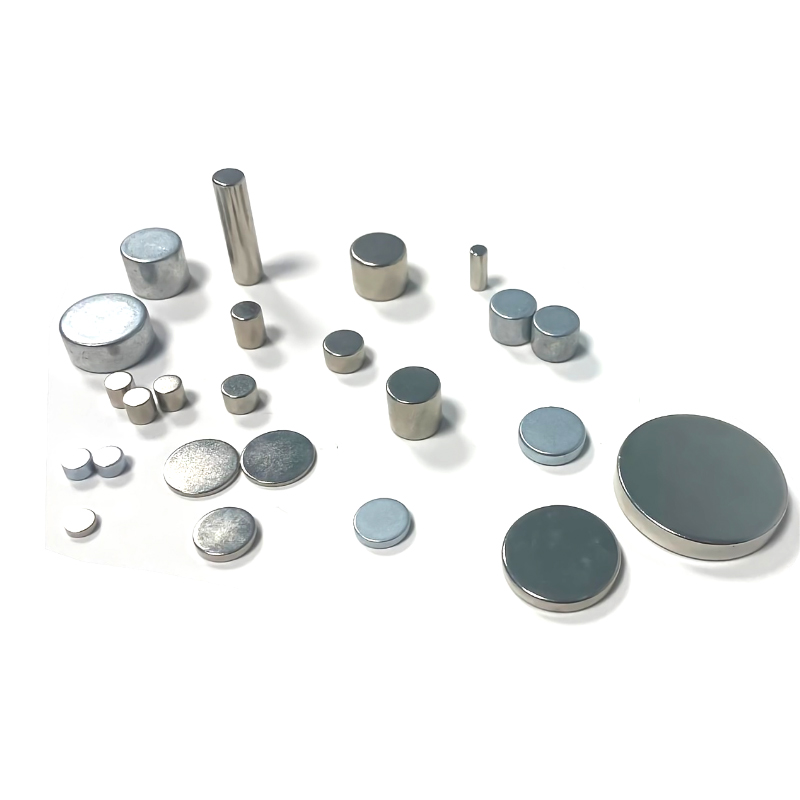
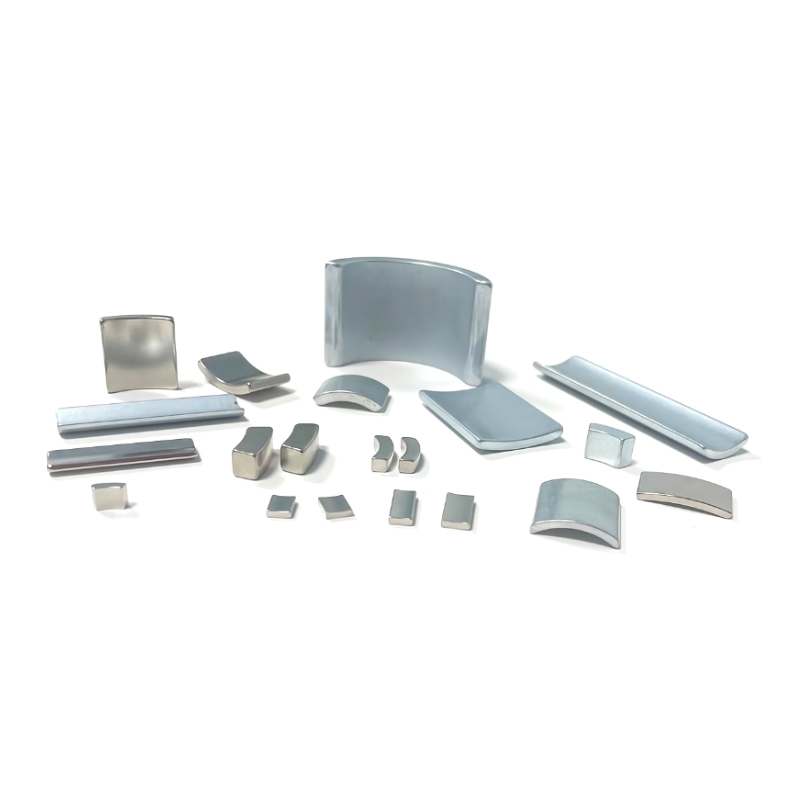
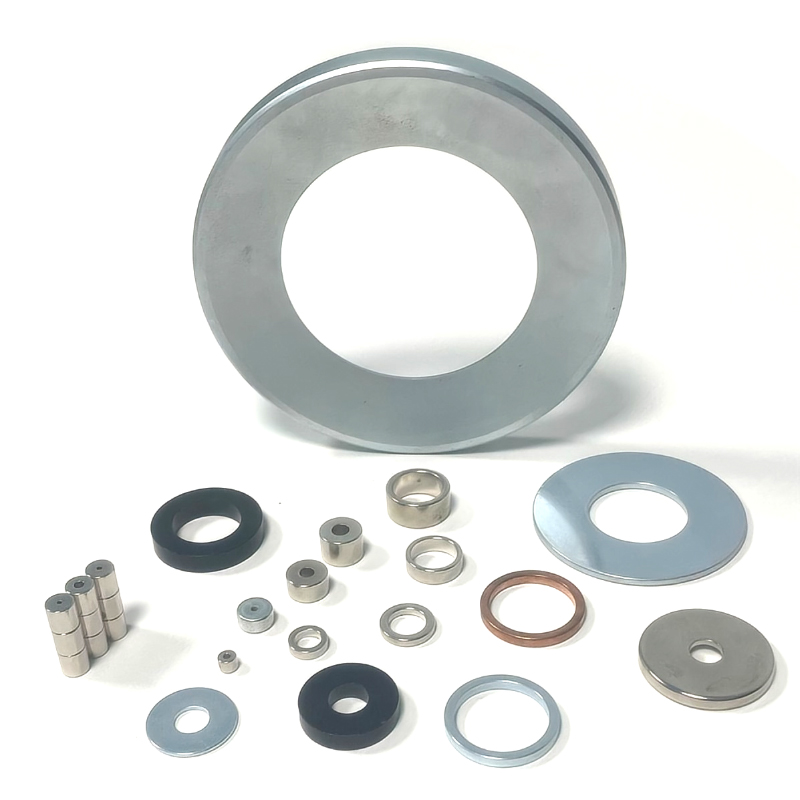
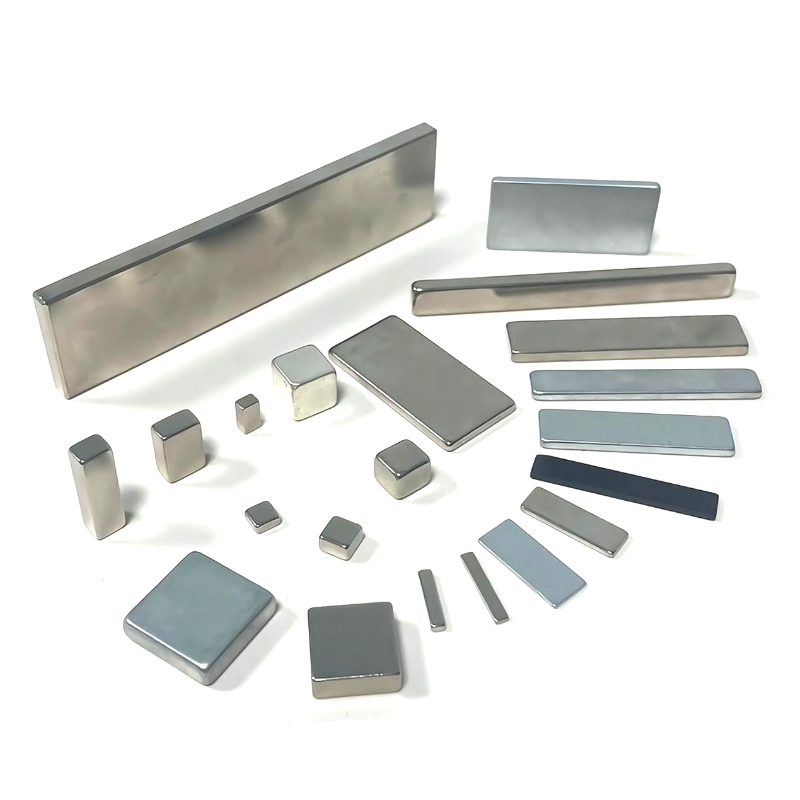
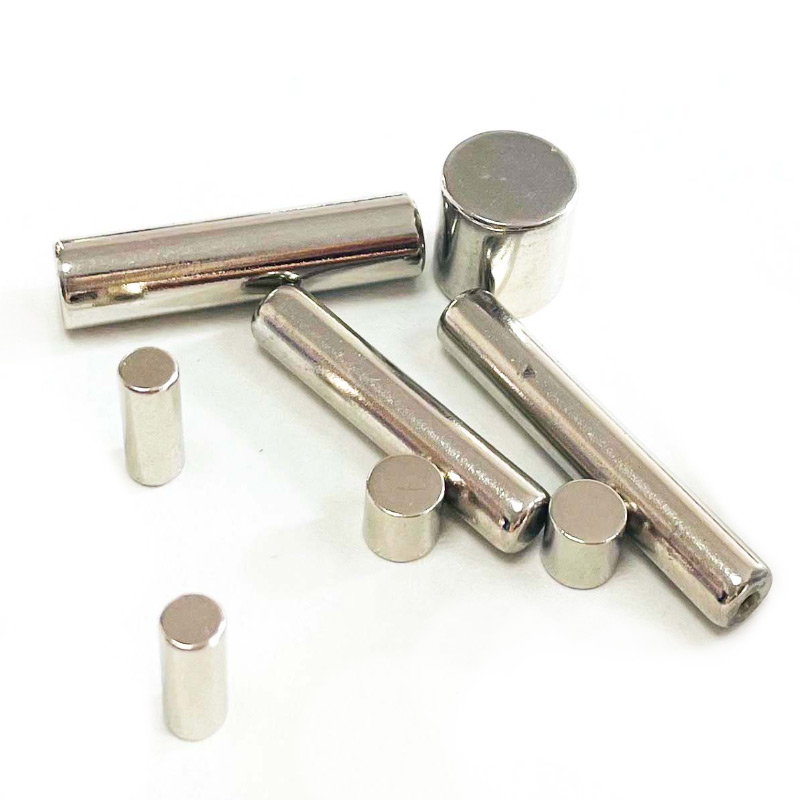
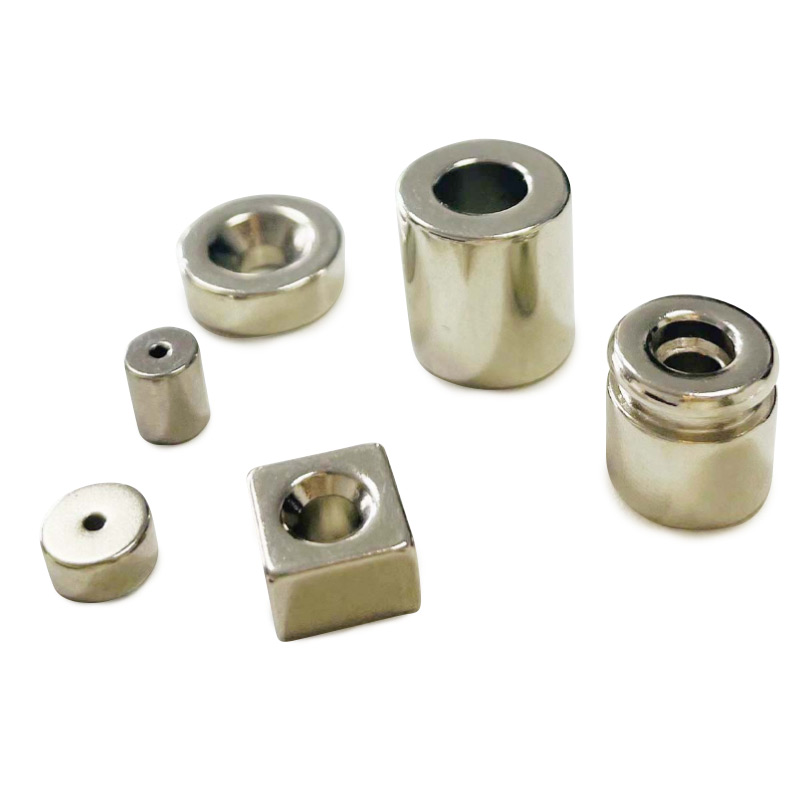
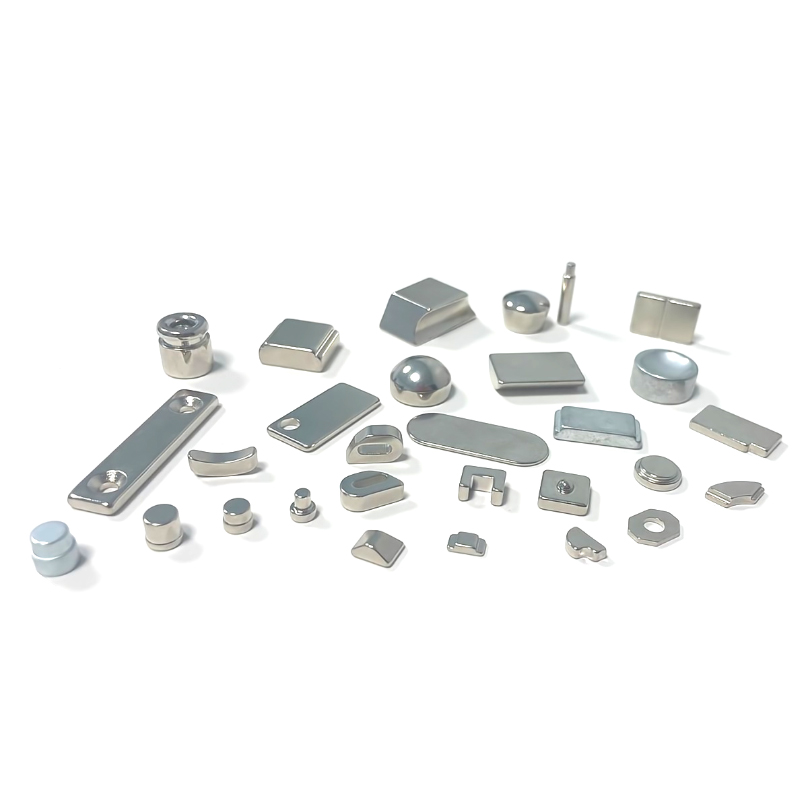
Beyond grade and coating, the physical shape and magnetization pattern of a magnet are central to how it performs within a magnetic circuit. Custom neodymium magnets are commonly produced in disc, block, arc or segment, ring, and rod geometries, each suited to different motor topologies and assembly methods.
Arc-shaped magnets are widely used in rotor assemblies for brushless DC motors, permanent magnet synchronous motors, and hub motors, where curved segments are arranged around a rotor core to generate a consistent magnetic field.
Ring magnets with multi-pole magnetization are frequently specified for compact rotor designs and sensor applications, allowing several magnetic poles to be encoded into a single component rather than assembled from multiple discrete pieces.
Block and disc shapes remain the most common general-purpose geometries, used across sensors, speakers, and industrial equipment where straightforward mounting and predictable field direction are priorities.
The column chart above presents an illustrative distribution of demand for custom NdFeB magnets across four major application sectors. New energy vehicles represent the largest share, consistent with the rapid growth of EV traction motors, hub motors, and hybrid vehicle motor systems that depend on high-temperature-resistant magnetic materials for sustained performance under continuous operation. Industrial automation follows closely, reflecting widespread use in servo motors, brushless DC motors, robotic joint motors, and magnetic separation equipment, all of which demand consistent torque output and long-term magnetic stability. Home appliances and consumer electronics account for a meaningful share as well, particularly in compressor motors, washing machine motors, and energy-efficient fan systems where compact, reliable magnets reduce overall product size. Medical and precision devices represent a smaller but highly specialized segment, where dimensional accuracy and magnetic consistency are critical for applications such as dental implant motors and micro-motors used in medical instruments. This distribution underscores why a magnet manufacturer with broad shape and grade flexibility is well positioned to serve multiple industries from a single production platform.
Selecting magnets for motor applications requires evaluating four factors together: grade strength, temperature suffix, coating system, and physical shape. A motor magnet used in an EV traction system, for instance, must withstand sustained operating temperatures, repeated thermal cycling, and mechanical vibration, which means a high-suffix grade with a robust coating typically outperforms a higher-number standard grade in long-term reliability.
For applications in industrial automation, such as servo motors and robotic joint motors, dimensional precision and consistent magnetic output across a production batch are often equally important as raw field strength, since variation between individual magnets can affect motor torque consistency. This is why working with a manufacturer capable of tight process control across magnetization, machining, and coating stages matters as much as the headline grade specification.
This radar chart compares the relative importance of six performance dimensions for EV traction motor magnets versus magnets used in consumer electronics. EV traction applications show consistently elevated requirements across nearly every dimension, with temperature resistance and vibration tolerance standing out as the most critical factors given continuous high-load operation and exposure to mechanical stress over the vehicle's service life. Consumer electronics applications, by contrast, place relatively higher emphasis on dimensional precision, since compact device housings demand tight tolerances, while requirements for vibration tolerance and coating durability are comparatively lower due to gentler operating conditions. Field strength requirements differ less dramatically between the two profiles, reflecting that both sectors benefit from strong magnetic performance, though the absolute grade chosen will still differ based on available space and thermal environment. This comparison illustrates why a single grade and shape cannot serve all applications equally well, and why working with a magnet manufacturer that supports both standard and fully custom magnetic solutions is valuable across diverse product lines. Recognizing these differing requirement profiles early in product design helps avoid costly magnet re-specification later in development.
Ningbo Tujin Magnetic Industry Co., Ltd. specializes in the manufacturing and sales of high-performance NdFeB magnets. With years of expertise in magnetic materials, the company provides high-temperature-resistant motor magnets and customized magnetic solutions engineered for superior precision and stability, serving as a trusted long-term partner for leading companies across multiple industries.
The company's NdFeB magnets are designed to maintain excellent magnetic performance across a wide thermal range, from -40°C to 200°C or higher, supporting demanding applications including new energy vehicle traction motors, hub motors, and hybrid vehicle motors. In industrial automation, Ningbo Tujin's magnets serve servo motors, PMSM and BLDC motors, robotic joint motors, industrial robots, and magnetic separation equipment, while also supporting home appliance and consumer electronics applications such as AC compressor motors, washing machine motors, and energy-efficient fans.
Beyond standard products, the company supports complex and precision-shaped magnet designs, including disc, block, arc or segment, ring with multi-pole magnetization, and rod geometries, catering to a wide range of magnetic circuit requirements. Advanced coating technologies, including Ni-Cu-Ni and epoxy systems, enhance oxidation resistance and extend product lifespan, while streamlined processes from design through mass production support shorter lead times for faster market entry. Beyond motors, Ningbo Tujin's magnets are also widely used in speakers, sensors, and wind power applications, reflecting the company's role as a comprehensive custom NdFeB magnets manufacturer and supplier for innovation-driven industries.
Q1: What do neodymium magnets do to your body?
Under normal handling and use, the magnetic field is not considered harmful to the human body since field strength diminishes quickly with distance. The main documented risks involve accidental ingestion of small magnets and pinching injuries from strong attractive force, rather than general field exposure.
Q2: What is the difference between N35 and N52 magnets?
N52 has a higher maximum energy product than N35, meaning greater magnetic strength for the same size. N35 tends to maintain more stable performance at elevated temperatures unless N52 is specified with an appropriate temperature suffix.
Q3: What are neodymium magnets used for?
They are used in motors for new energy vehicles, industrial automation equipment, home appliances, medical devices, and energy systems, as well as in speakers, sensors, and wind power applications.
Q4: What does the letter suffix after a magnet grade mean?
The suffix letter, such as M, H, SH, UH, EH, or AH, indicates the magnet's maximum recommended operating temperature and resistance to demagnetization, separate from the strength indicated by the grade number.
Q5: Can NdFeB magnets be custom shaped for specific motor designs?
Yes, custom shapes such as disc, block, arc, ring, and rod geometries are commonly produced to match specific magnetic circuit and motor design requirements, often with multi-pole magnetization for compact assemblies.
No.107 Yunshan Industry Park, Sanqishi Town, Yuyao, Ningbo, Zhejiang 315412, China
+86-18858010843
sales@tujinmagnet.com
Copyright ? Ningbo Tujin Magnetic Industry Co., Ltd. All Rights Reserved. Custom Rare Earth Magnets Factory