-

sales@tujinmagnet.com
-

+86-18858010843

Content
When a procurement engineer receives two quotations for the same N42SH grade arc magnet, the composition lines on the material certificates rarely match. One NdFeB magnet manufacturer may list a higher neodymium content, while the other lists a higher dysprosium content. Both magnets can pass the basic specification, yet their behavior at 160 °C will not be identical.
For motor engineers and sourcing teams, NdFeB magnet composition is therefore not a laboratory detail. The alloy determines how much magnetic flux the rotor produces, how well the magnet resists demagnetization at high temperature, how quickly it corrodes in a humid environment, and how much the finished motor costs to build. A magnet that fails in the field is usually a magnet whose composition was never verified.
This article explains the composition of commercial sintered NdFeB magnets element by element. It covers typical weight percentages, the function of each additive, how composition translates into grades such as N35, N42, N45SH, and N52, and which questions to ask before placing a wholesale order with a supplier. The goal is to give engineers and buyers a practical reference for specifying, validating, and sourcing motor-grade sintered magnets.
NdFeB stands for neodymium, iron, and boron, the three elements that form the main magnetic phase of the magnet. This phase has the chemical formula Nd2Fe14B and a tetragonal crystal structure with a high uniaxial magnetocrystalline anisotropy. In the unit cell, 68 atoms are arranged in a precise pattern: 16 neodymium atoms, 56 iron atoms, and 8 boron atoms. It is this atomic arrangement that gives the magnet its extreme maximum energy product, which is why NdFeB is the strongest commercial permanent magnet material available.
On paper, a pure Nd2Fe14B crystal contains about 26.7% neodymium, 72.3% iron, and 1.0% boron by weight. But a commercial NdFeB magnet is never made from the pure phase alone. Manufacturers deliberately add two to five extra percentage points of neodymium so that a thin, neodymium-rich phase forms at the grain boundaries. During sintering, this boundary phase melts at roughly 1030–1080 °C and wets each Nd2Fe14B grain, which removes surface defects and prevents adjacent grains from coupling magnetically. Without this extra neodymium, coercivity collapses and the magnet cannot tolerate the fields used to magnetize or demagnetize it.
The practical result is that a commercial sintered alloy contains slightly more neodymium and a little less iron than stoichiometry suggests, with boron held in a very tight window. A typical material certificate lists neodymium at 29.0–32.0%, iron at 64.2–68.5%, and boron at 1.0–1.2%, plus a group of small additives that we will examine later in this article.
| Element | Typical content (weight %) | Primary role |
|---|---|---|
| Neodymium (Nd) | 29.0–32.0 | Provides anisotropy and coercivity; forms the Nd-rich grain boundary phase |
| Iron (Fe) | 64.2–68.5 | Carries most of the magnetic flux and defines remanence |
| Boron (B) | 1.0–1.2 | Stabilizes the Nd2Fe14B phase and prevents soft magnetic iron phases |
| Praseodymium (Pr) | 0–1.5 | Substitutes for neodymium and reduces material cost |
| Dysprosium (Dy) | 0–6.0 (H, SH, UH, EH) | Raises coercivity and maximum operating temperature |
| Cobalt (Co) | 0–1.0 | Improves Curie temperature and temperature coefficient |
| Aluminium (Al) | 0.2–0.4 | Improves grain boundary wetting and coercivity |
| Niobium (Nb) | 0.3–0.6 | Refines grain size and stabilizes the microstructure |
| Copper (Cu) | 0–0.2 | Enhances coercivity and corrosion uniformity |
| Gallium (Ga) | 0–0.1 | Very effective coercivity promoter at low content |
The composition also contains impurities that must be kept very low, especially oxygen and carbon. A typical sintered magnet holds oxygen below 500 ppm and carbon below 500 ppm, because both elements react with neodymium and reduce the effective rare-earth content. A manufacturer that controls these residuals tightly will produce magnets with more consistent coercivity and fewer batch-to-batch surprises.
Neodymium is the element that makes an NdFeB magnet strong. Its 4f electron shell produces a very high magnetocrystalline anisotropy, meaning the electron spin system strongly prefers to align along one crystal axis. In the Nd2Fe14B lattice, that uniaxial anisotropy is the source of intrinsic coercivity, the property that allows a magnet to resist demagnetization. Commercial alloys carry 29–32% neodymium by weight, slightly above the stoichiometric level of the pure phase. The surplus neodymium segregates to grain boundaries as an Nd-rich phase that improves sintering behavior and heals surface defects on the Nd2Fe14B grains.
Iron contributes the majority of the magnet's flux. Iron atoms inside the Nd2Fe14B structure carry most of the exchange-coupled spin moment, so removing iron and replacing it with nonmagnetic elements lowers remanence. Iron is also the cheapest element in the alloy, and a high iron fraction keeps material cost down. However, iron cannot be increased indefinitely. If the alloy cools with too much iron, soft magnetic α-Fe precipitates form and short-circuit the hard magnetic phase, dropping coercivity sharply. This is why boron is essential rather than optional.
Boron is present at only 1.0–1.2% by weight, but it controls the entire phase structure. Boron stabilizes the tetragonal Nd2Fe14B compound; without it, the alloy separates into Nd2Fe17 and α-Fe, both of which are soft magnetic and useless for a permanent magnet. The boron window is intentionally tight. Too little boron leaves free iron, creating magnetically soft regions. Too much boron forms an Fe2B phase that is nonmagnetic and dilutes the flux. The presence of boron is also the reason NdFeB magnets can be produced with just three dominant elements rather than requiring the samarium and cobalt used in earlier rare-earth magnet families.
Beyond the three base elements, every serious NdFeB supplier uses a small group of additives to fine-tune coercivity, temperature sensitivity, corrosion resistance, and cost. The percentages are tiny, but their effect on a finished motor magnet is disproportionately large.
Praseodymium and neodymium coexist in most rare-earth ores, and the two form a continuous solid solution in the Nd2Fe14B lattice. Manufacturers therefore accept praseodymium as a partial substitute, typically up to about 1.5%. Praseodymium slightly lowers the anisotropy field, but the practical loss in remanence is negligible. Its main value is cost, because separating praseodymium from neodymium is expensive. Many suppliers report a combined "Pr+Nd" content on the certificate instead of listing the two separately.
Dysprosium is the most common heavy rare-earth element used in high-temperature NdFeB grades. It increases the anisotropy field of the magnet, which raises intrinsic coercivity and pushes the maximum operating temperature upward. The penalty is a drop in remanence, and the financial penalty is even larger because dysprosium is several times more expensive than neodymium. Terbium works even better per percentage point but costs more, so it is reserved for extreme EH and AH grades, usually applied by grain boundary diffusion rather than added to the whole melt.
Cobalt partially substitutes for iron and raises the Curie temperature of the alloy from about 310 °C to roughly 350 °C. It also improves the reversible temperature coefficient of remanence, moving it from about -0.12% per degree Celsius toward -0.09% per degree Celsius. Motor magnets exposed to wide ambient swings benefit from even 0.5–1.0% cobalt. Excessive cobalt, however, reduces coercivity slightly and increases cost.
These elements are deliberately placed in the Nd-rich grain boundary phase rather than in the Nd2Fe14B grains. They improve the wetting behavior of the liquid phase during sintering, creating smoother boundaries that block magnetization reversal more effectively. Copper also contributes to more uniform corrosion behavior, and gallium is surprisingly powerful: as little as 0.1% can lift coercivity noticeably, which is why it appears even though its unit price is high.
Niobium and zirconium inhibit grain growth during sintering. A finer grain size raises coercivity and improves the squareness of the demagnetization curve, which matters when a motor operates close to its worst-case demagnetizing field. By keeping the grain structure fine, a manufacturer can achieve a target coercivity with slightly less dysprosium, reducing both cost and remanence loss.
| Element | Typical addition (weight %) | Effect on remanence | Effect on coercivity | Effect on temperature behavior |
|---|---|---|---|---|
| Praseodymium | 0–1.5 | Neutral to slightly positive | Neutral | Neutral |
| Dysprosium | 0–6.0 | Reduces by roughly 0.3–0.5% per 1% Dy | Strongly improves | Raises maximum operating temperature |
| Terbium | 0–2.0 | Reduces slightly | Improves more than Dy per unit | Raises maximum operating temperature |
| Cobalt | 0–1.0 | Neutral | Slightly reduces | Improves Curie temperature and temperature coefficient |
| Aluminium | 0.2–0.4 | Neutral | Improves | Neutral |
| Copper | 0–0.2 | Slightly reduces | Improves | Neutral |
| Gallium | 0–0.1 | Neutral | Strongly improves per unit | Neutral |
| Niobium | 0.3–0.6 | Slightly reduces | Improves via grain refinement | Neutral |
The grade designation of a sintered NdFeB magnet is shorthand for a minimum magnetic property set. The letter N stands for normal coercivity, and the number refers to the maximum energy product in MGOe. N35 typically has a remanence of 1170–1220 mT, while N52 reaches 1420–1470 mT. The jump from N35 to N52 is achieved mainly by raising the sintered density, improving grain orientation in the magnetic field, and reducing nonmagnetic phases inside the magnet, while keeping the base composition in the same neodymium range.
Composition enters the picture through the heavy rare earths. A standard N-grade magnet contains almost no dysprosium. The moment a buyer asks for H, SH, UH, or EH temperature capability, the manufacturer must add dysprosium or terbium, or use grain boundary diffusion. This change is invisible in the remanence grade number but highly visible in price and high-temperature behavior.
Temperature letters are not decided by the remanence number. They are decided by the intrinsic coercivity that the alloy can deliver. To reach a higher Hcj, the manufacturer raises the heavy rare-earth content of the alloy. Dysprosium is the most widely used element for this purpose because it increases the anisotropy field of the Nd2Fe14B phase. The chart below shows a typical dysprosium addition across the temperature grades built on the same N35 remanence level.
The trend is consistent: each step from N to EH requires a substantially larger dysprosium addition. An N35H magnet typically contains about 1.5% dysprosium by weight. An N35SH grade needs about 3.0%, an N35UH about 4.5%, and an N35EH as much as 6.0% or more. These are indicative figures because the exact amount depends on grain size, oxygen level, and whether the supplier uses grain boundary diffusion. The first practical consequence is cost, since dysprosium is several times more expensive than neodymium. The second consequence is remanence loss, because dysprosium dilutes the magnetization of the main phase. For every additional weight percent of dysprosium, the residual flux density drops by roughly 0.3–0.5% compared with the same alloy without the addition.
This trade-off explains why an N45SH motor magnet may carry less remanence than an N45 magnet, yet survive a demagnetizing field that would erase the N45 in seconds. A motor designer should not pick the highest letter grade just to be safe, because the extra heavy rare earth costs money and reduces flux. Modern suppliers increasingly use grain boundary diffusion to place dysprosium exactly where it blocks magnetization reversal, cutting heavy rare-earth consumption by 60–80% for the same coercivity. This is why two manufacturers quoting the same grade can still deliver different compositions and different prices. The buyer should always ask whether the coercivity comes from uniform alloy additions, from grain boundary diffusion, or from a combination of both. The answer affects long-term supply security and every future quotation.
| Designation | Remanence Br (mT) | Coercivity Hcj (kA/m) | Max operating temperature | Typical heavy rare-earth content |
|---|---|---|---|---|
| N35 | 1170–1220 | ≥ 955 | 80 °C | 0–0.5% Dy |
| N42 | 1290–1330 | ≥ 955 | 80 °C | 0–0.5% Dy |
| N45SH | 1320–1370 | ≥ 1592 | 150 °C | ~3% Dy |
| N48UH | 1360–1420 | ≥ 1990 | 180 °C | ~4.5% Dy |
| N52 | 1420–1470 | ≥ 876 | 80 °C | 0–0.5% Dy |
The maximum operating temperatures above are approximate and assume a permeance coefficient around 2. A thin arc segment may require a higher temperature letter at the same ambient temperature because its shape produces a stronger self-demagnetizing field.
Permanent magnets lose flux as temperature rises. The reversible temperature coefficient of remanence for a standard NdFeB alloy is about -0.11 to -0.12% per degree Celsius, so at 150 °C the magnet quietly loses roughly 15% of its room-temperature flux. More dangerous is the behavior of coercivity. The intrinsic coercivity Hcj falls at about -0.5 to -0.6% per degree Celsius, which means the magnet's ability to resist an opposing field decays much faster than its flux.
The maximum working temperature is reached when the intrinsic coercivity drops close to the demagnetizing field that the magnet actually sees in service. This is why grade selection cannot be done from a table alone. A thin flat arc magnet with a permeance coefficient of 1.0 experiences a much stronger self-demagnetizing field than a thick block with a coefficient of 3.0, and therefore needs a higher coercivity grade at the same ambient temperature. A magnet that operates at 150 °C with only its sticker temperature as guidance is a reliability risk, not a design.
For motor applications above 150 °C, the composition must contain a meaningful amount of dysprosium or terbium, or the grain boundaries must be diffused with heavy rare earth. We regularly evaluate how temperature variations affect the performance of neodymium ring magnets because the annular shape has a particularly strong demagnetizing effect on the inner bore. Adding cobalt to the alloy helps in a different way: it raises the Curie temperature and softens the temperature coefficient of remanence, which slows the flux decline between 100 °C and 180 °C.
The composition discussed so far describes sintered NdFeB magnets, which are the standard for motor rotors because they offer the highest flux and the highest temperature capability. Sintered magnets are fully dense alloys with a density of 7.4–7.6 g/cm3, produced by liquid-phase sintering at high temperature to develop the hard magnetic microstructure.
Bonded NdFeB magnets are a different family. They start with a neodymium-iron-boron powder, but the powder is mixed with an organic binder, typically epoxy for compression bonding or nylon for injection molding. The binder occupies a significant volume fraction: compression-molded magnets carry roughly 3–5% binder by weight, and injection-molded parts up to 12% or more. The powder itself is also formulated differently. Bonded powders contain less neodymium-rich grain boundary material because there is no sintering step and the boundary phase is not needed for densification. Manufacturers add more cobalt and sometimes zirconium or niobium to improve the corrosion resistance of the bare powder, since the polymer binder does not fully isolate every particle from moisture.
| Property | Sintered NdFeB | Bonded NdFeB |
|---|---|---|
| Density | 7.4–7.6 g/cm3 | 5.5–6.2 g/cm3 |
| Remanence | 1.17–1.47 T | 0.55–0.95 T |
| Maximum energy product | 35–52 MGOe | 8–18 MGOe |
| Maximum operating temperature | 80–200 °C by grade | 100–150 °C depending on binder |
| Corrosion resistance | Requires coating | Better in mild environments |
| Shape freedom | Machined from sintered blocks | Direct injection molding possible |
| Typical tolerance | ±0.05 mm or better by grinding | ±0.03 mm in molding direction |
For motor shafts, rotors, and high-efficiency drives, sintered grades dominate because their energy density is irreplaceable. Bonded magnets appear in very small brushless motors, pumps, encoders, and other devices where the low cost of a complex near-net shape outweighs the lower flux. The two families should never be compared by grade number alone, because their composition logic and their application limits are completely different.
The alloy composition is fixed before the magnet is pressed, but the final magnetic properties are decided during the process. A typical sintered NdFeB production line follows a well-established route:
Every step shifts the effective composition slightly. Oxygen pickup during powder handling converts some neodymium into an oxide that no longer contributes to the liquid phase, so a manufacturer with poor handling must compensate with extra rare earth. Sintering temperature controls grain size, and grain size controls how much dysprosium is needed to reach the target coercivity. A well-run process can achieve a sintered density above 7.45 g/cm3, which usually correlates with remanence close to the theoretical maximum.
This is why a buyer should rely on measured data rather than a nominal composition. A reliable full NdFeB technical data sheet should state the magnetic performance, dimensions tolerance, surface coating, and magnetization direction of each grade. The composition is then best confirmed by a batch certificate using inductively coupled plasma analysis.
The same neodymium-rich grain boundary phase that enables sintering is also the weak point of the magnet. The Nd-rich phase is electrochemically active, and in humid or saline environments it corrodes preferentially along the grain boundaries. An uncoated NdFeB magnet can lose its surface structure within hours in a salt spray chamber and within months in an outdoor motor. For this reason, nearly every industrial NdFeB magnet receives a surface treatment before leaving the factory.
Coating selection interacts with composition and application. Nickel-copper-nickel has become the most common coating for motor magnets because it is hard, smooth, and provides a consistent thickness across the surface. Zinc offers sacrificial protection and a lower cost. Epoxy works well for irregular shapes where plating thickness is difficult to control. For oil-cooled traction motors, special resins or high-quality nickel platings are preferred after compatibility testing with the cooling fluid.
| Coating type | Typical thickness | Max service temperature | Salt spray resistance | Notes |
|---|---|---|---|---|
| Ni-Cu-Ni | 12–25 µm | 200 °C | 96–500 h depending on quality | Standard for motor magnets; hard and uniform |
| Zinc | 8–15 µm | 120 °C | 24–72 h | Sacrificial and economical |
| Epoxy | 15–30 µm | 150 °C | 200–500 h | Good edge coverage, no galvanic interaction |
| Phosphating | 1–3 µm | 200 °C | Low on its own | Pretreatment layer often used with oil |
| Gold | 3–8 µm | 250 °C | Very high | Used for medical and precision instruments |
Coating thickness adds to the overall dimension, and a plated magnet with 25 µm of nickel grows by 50 µm across the full dimension. Precision motor assemblies usually specify the coating and the final dimension as one combined tolerance to avoid interference fits. The best NdFeB magnet composition will fail early if the coating does not match the operating environment, so the coating should be part of the grade specification, not an afterthought.
A practical selection starts with five questions: what is the maximum continuous temperature at the magnet location, what demagnetizing field can appear during starting or overload, what flux density does the rotor need, what is the corrosion environment, and what is the cost target. When these numbers are known, the composition decision becomes a short list rather than a guess.
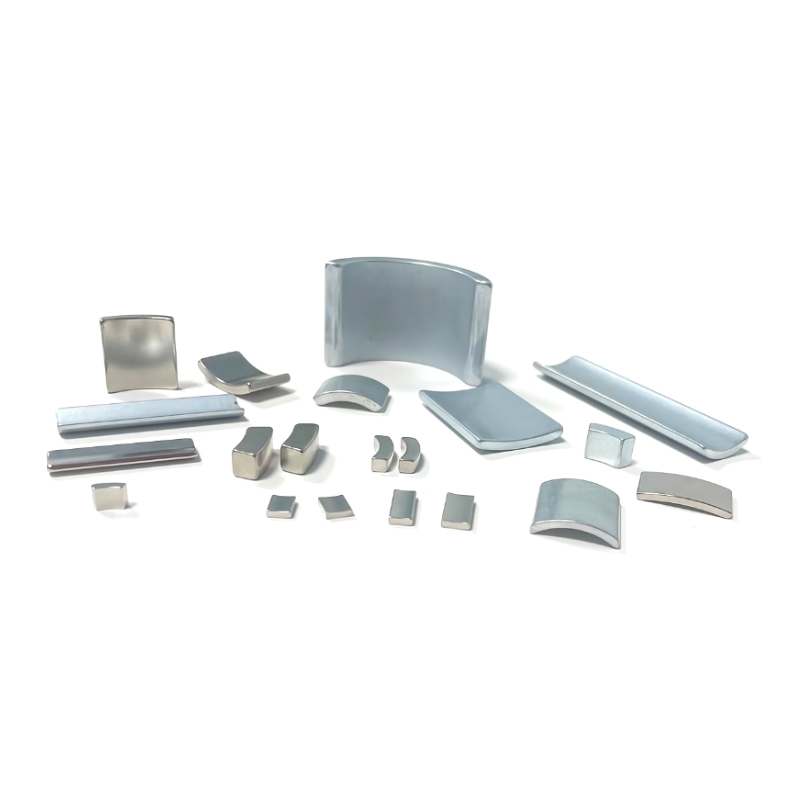
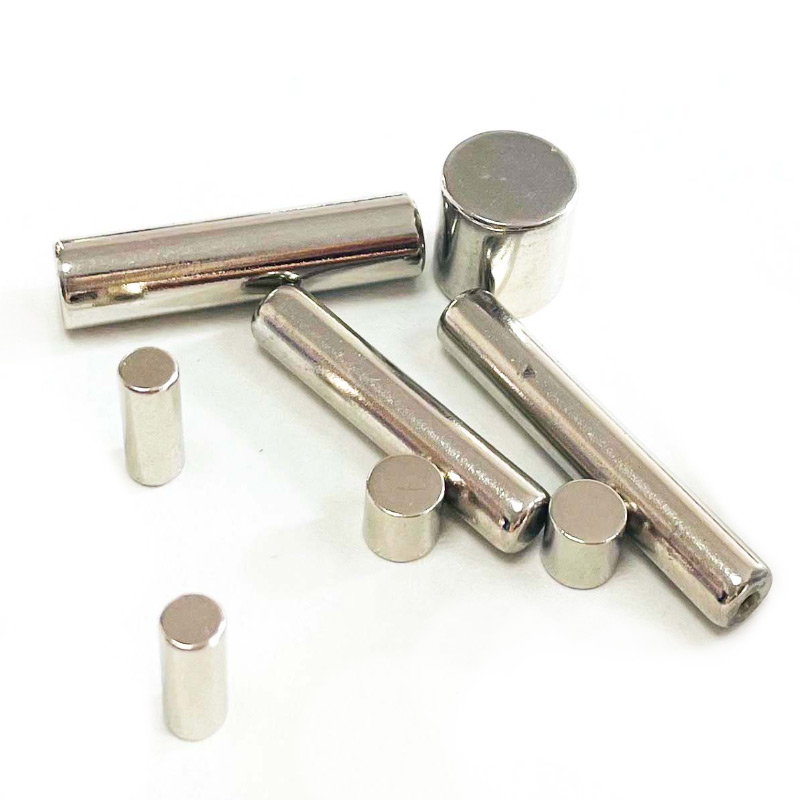
For a traction motor or a servo motor, the rotor magnets are usually arc segments magnetized radially. In this geometry, the working temperature and the overload current define the minimum temperature letter, while the energy product defines the remanence. Many motor builders use N38SH or N42SH for servo drives and N38UH or N42EH for the heavier thermal cycles of a traction drive. Research on how neodymium arc magnets reduce the volume and weight of motors shows that a higher performance magnet can shrink the rotor package without increasing cost per kilowatt. Our custom arc magnets for electric motors are produced with tight control on the radial wall, which directly stabilizes the air-gap flux and reduces cogging torque.
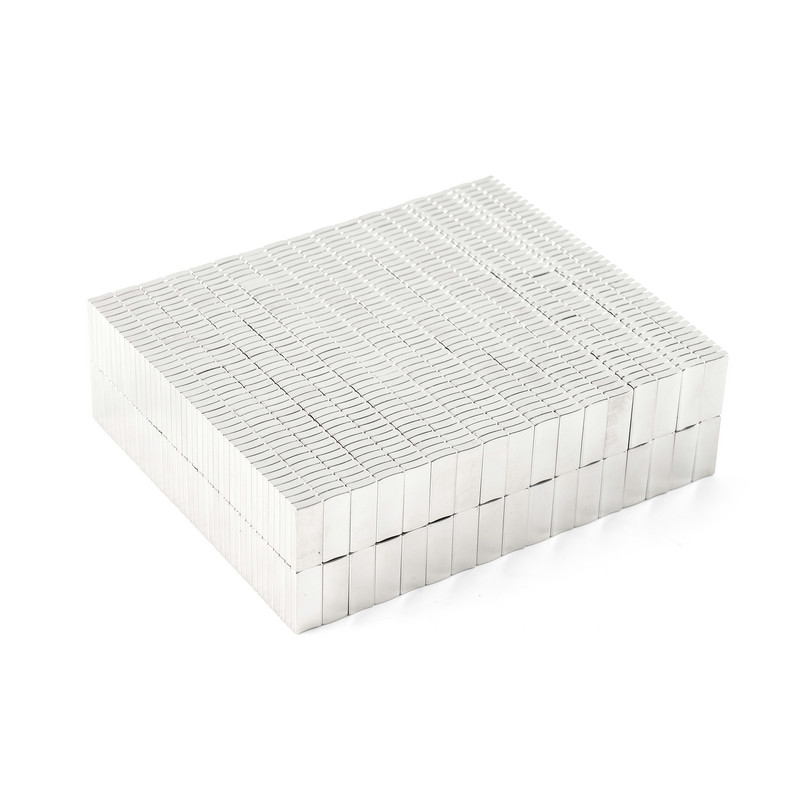 Custom Neodymium NdFeB Arc Magnets Manufacturer, SuppliersNingbo Tujin Magnetic Industry Co., Ltd. is China Neodymium Arc magnet manufacturer and neodymium Ndfeb Arc magnets suppliers, Our compan...View Product →
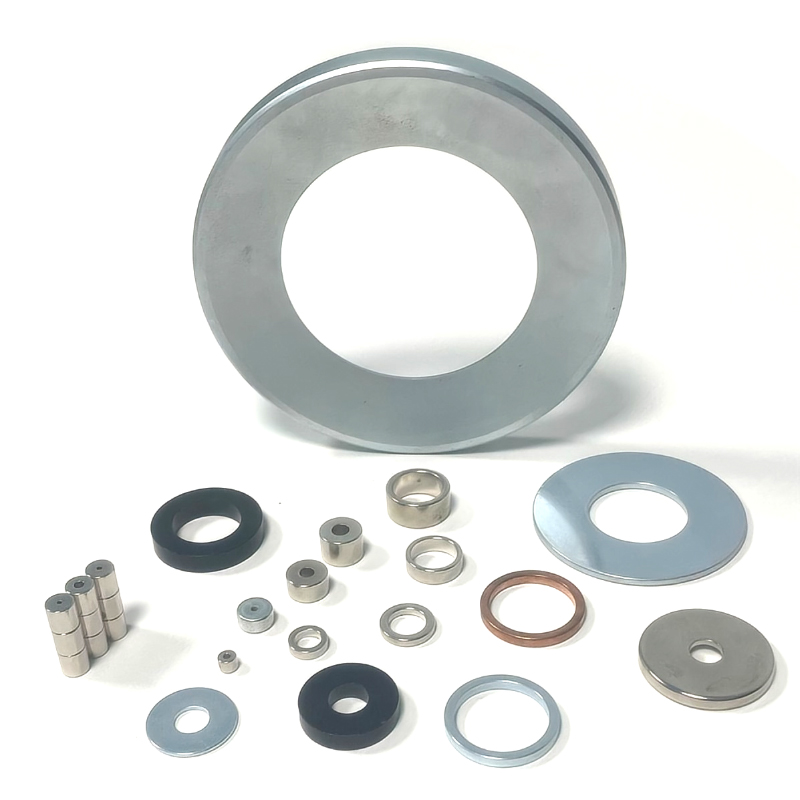
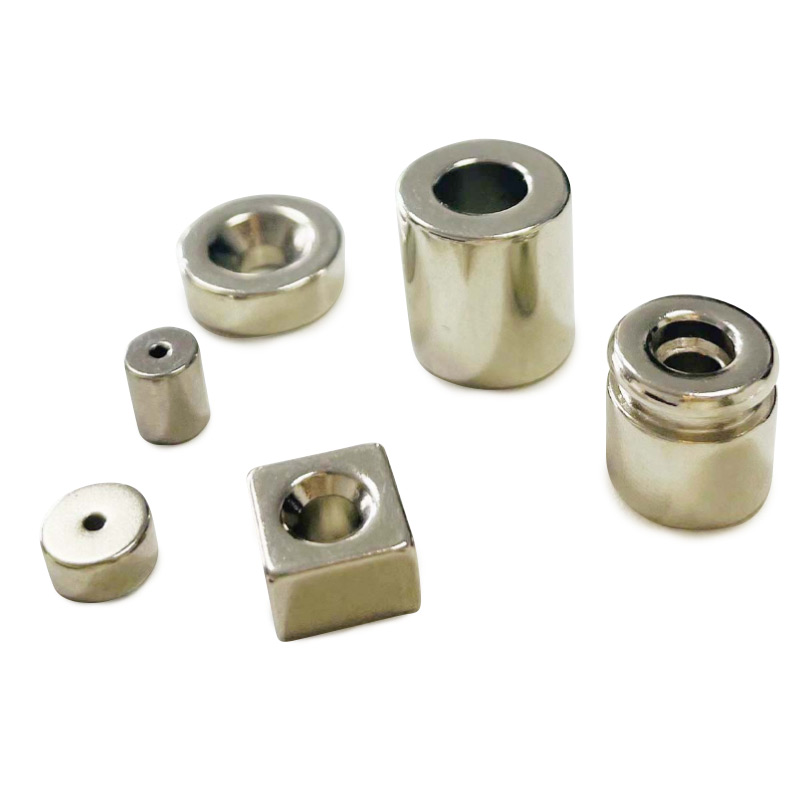
Where the shaft must pass through the magnet, for example in electric power steering, small pumps, or auxiliary fans, ring magnets are the natural choice. The annular cross-section reduces the magnetic material area, so both the grade and the bore tolerance must be exact. Sintered neodymium ring magnets are ground on the inner and outer diameters, and the composition is selected so that the coercivity remains above the operating demagnetizing field at the inner bore.
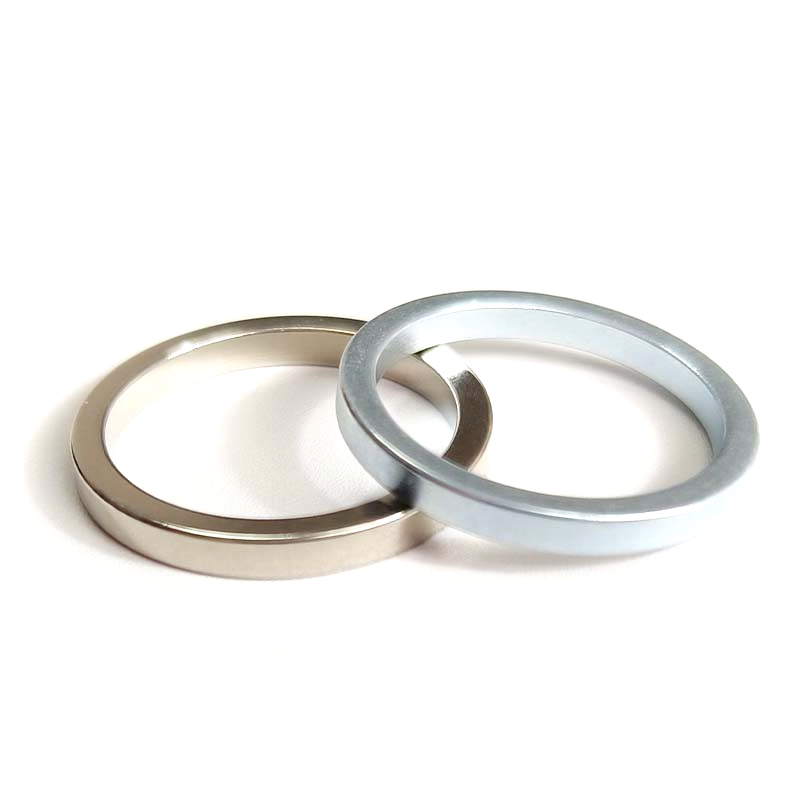 Custom Neodymium NdFeB Ring Magnets Manufacturer, SuppliersNingbo Tujin Magnetic Industry Co., Ltd. is China Neodymium ring magnet manufacturer and neodymium Ndfeb ring magnets suppliers, Our comp...View Product →
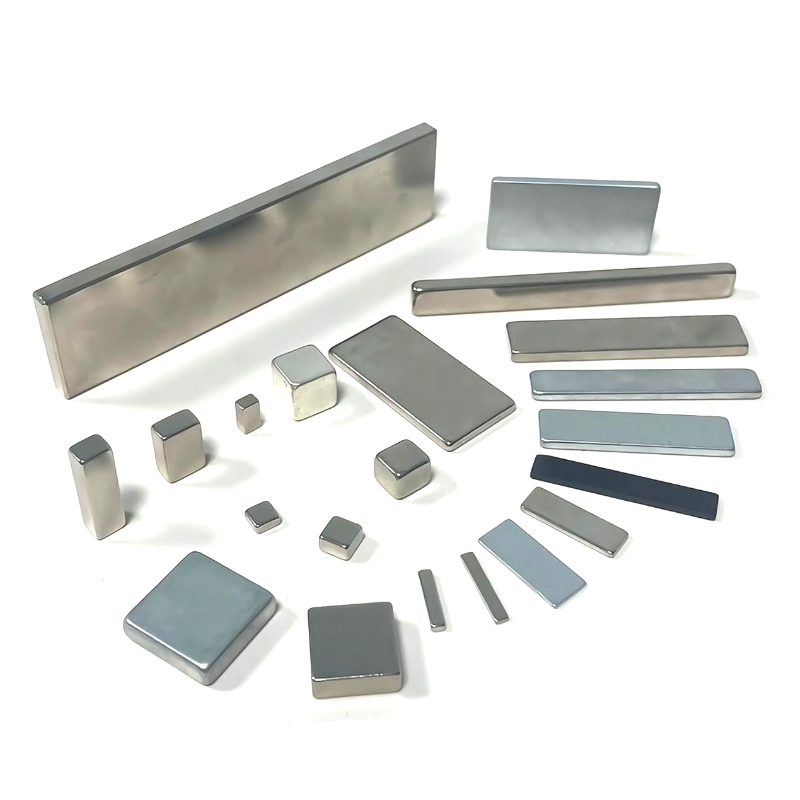
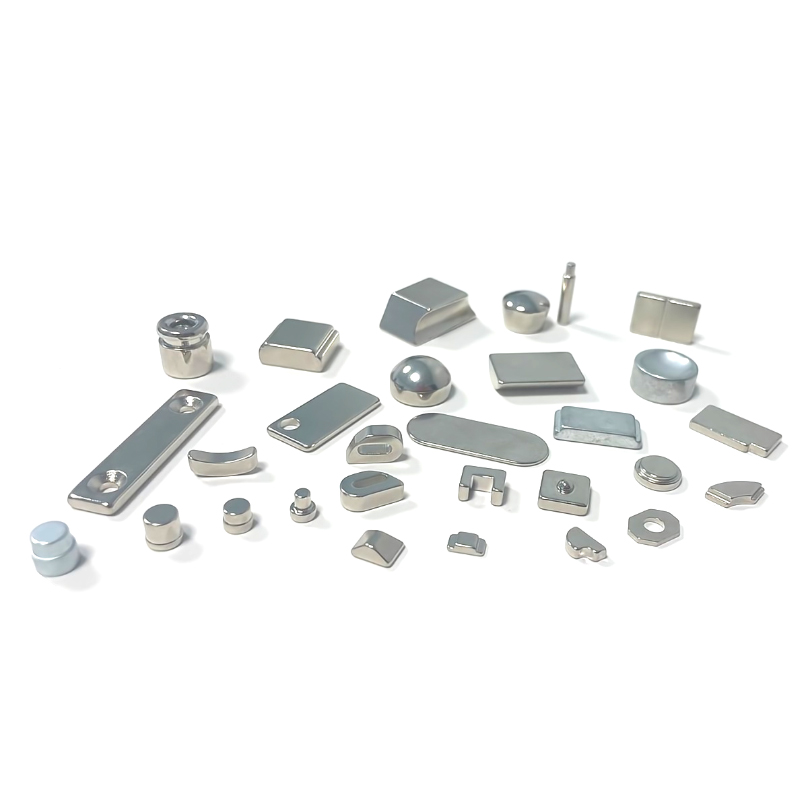
When a standard geometry cannot fit the rotor design, the next step is a customized shape. The composition can remain a standard grade, while the geometry, coating, and magnetization direction are adapted to the assembly. Customized NdFeB shapes include countersunk blocks, stepped cylinders, trapezoids, and multi-part magnet assemblies, all produced from the same verified alloys.
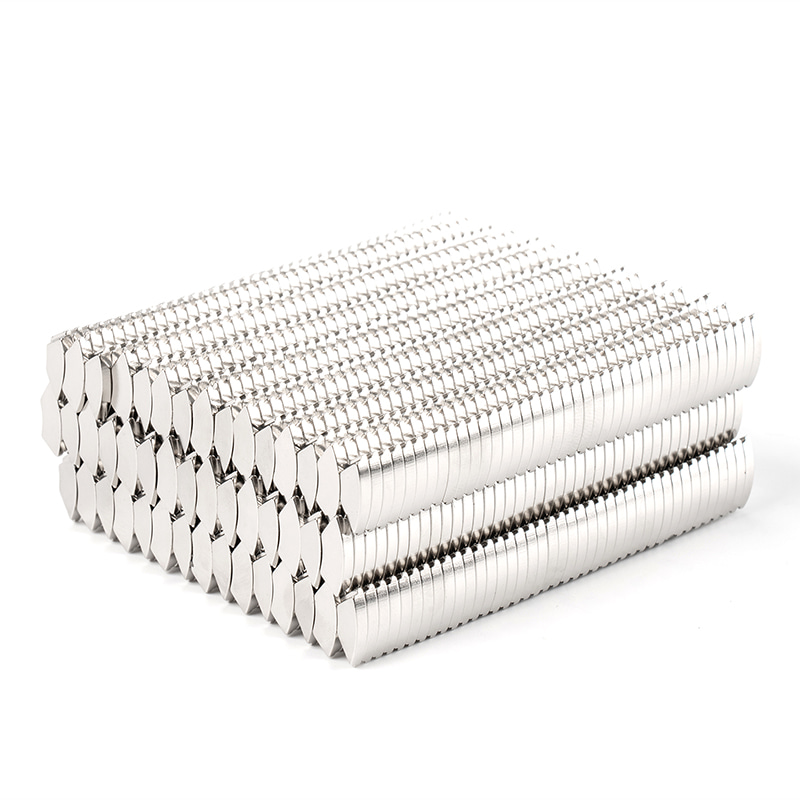 Custom Special Shapes Neodymium Ndfeb Magnets ManufacturerNingbo Tujin Magnetic Industry Co., Ltd. is China custom special shapes neodymium magnets manufacturer and special shapes ndfeb magnets s...View Product →
EV traction motorContinuous hotspot up to 180 °C and overload current that produces a strong opposing field. Selection focus: N38UH/N42EH or N38AH with grain boundary diffusion; high Hcj at 180 °C; thin arc segments with tight wall tolerance; oil-compatible coating. Budget the heavy rare-earth cost consciously. |
Industrial servo motorContinuous operation at 120–150 °C with frequent speed changes and high dynamic loads. Selection focus: N38SH/N42SH arc magnets; consistent remanence across batches for torque linearity; balanced temperature coefficient; nickel plating with uniform 15–20 µm; magnetization pattern agreed on the drawing. |
Beyond these two scenarios, motor magnet specifications can be grouped into common configuration types:
The difference between a cheap magnet and the right magnet is rarely the shape. It is the match between composition and operating conditions. A serious NdFeB magnet manufacturer will ask for the full load profile before recommending a grade, because the alloy cannot be improved after the magnet is sintered.
Rare-earth markets are far from stable. Neodymium, praseodymium, and especially dysprosium prices have shown large swings, and most of the world's sintered NdFeB production is concentrated in China. For a buyer, this means composition is also a supply-chain decision. A design locked to 6% dysprosium is exposed to heavy rare-earth price volatility, while a design that uses grain boundary diffusion or a lower dysprosium content carries a different, often better, cost profile.
The best protection is transparency. Before ordering, ask the supplier for a material certificate that lists the chemical composition range, the density, the magnetic properties, and the coating specification for each batch. Where possible, verify the NdFeB magnet composition with an independent laboratory using ICP analysis on random samples. Also request the demagnetization curves at the real operating temperature, not just at room temperature, because the squareness of the curve at elevated temperature reveals how well the composition and grain boundary were engineered.
Because we are an NdFeB magnet manufacturer and wholesale magnet supplier in Ningbo, composition review is part of our quotation process. We confirm the working temperature range, the expected demagnetizing field, and the corrosion class before recommending a grade. For OEM projects, we provide pre-production samples and a material certificate with each batch, and we support customers with the technical data they need in their motor design reviews.
How does NdFeB magnet composition differ from the pure Nd2Fe14B formula?The pure Nd2Fe14B phase corresponds to roughly 26.7% neodymium, 72.3% iron, and 1.0% boron by weight. Commercial sintered magnets contain two to five extra percentage points of neodymium because the surplus forms a grain boundary phase that enables liquid-phase sintering and isolates the magnetic grains. Practical composition ranges are therefore about 29–32% neodymium, 64.2–68.5% iron, and 1.0–1.2% boron, plus small quantities of dysprosium, cobalt, aluminium, niobium, and other additives. |
Why do commercial NdFeB alloys contain more neodymium than the stoichiometric phase requires?The extra neodymium forms a thin intergranular phase that melts during sintering at about 1030–1080 °C. This liquid phase wets the Nd2Fe14B grains, removes surface defects, and prevents adjacent grains from coupling magnetically. Without it, coercivity is poor and the sintered density is low. The Nd-rich phase is therefore not waste; it is a functional component of the NdFeB magnet composition that directly controls coercivity and thermal stability. |
What is the role of dysprosium in NdFeB magnet composition, and why is it so controversial?Dysprosium increases the anisotropy field of the magnet and therefore raises intrinsic coercivity and maximum operating temperature. It is the standard element for H, SH, UH, and EH grades. The controversy comes from cost and supply: dysprosium is expensive, its mining has a heavy environmental footprint, and its price is volatile. Many manufacturers now use grain boundary diffusion to put dysprosium only at the grain boundaries, reducing total consumption by 60–80% while keeping the same coercivity. |
Can the composition of a finished NdFeB magnet be verified?Yes. Inductively coupled plasma optical emission spectroscopy, usually called ICP-OES, is the standard method for checking neodymium, iron, boron, and trace additives in a sintered magnet. Buyers can request a mill certificate with ICP results per batch, or send random samples to an independent laboratory. Density measurement and magnetic testing at the rated temperature are useful complements, because they confirm that the composition was actually converted into the expected microstructure. |
Which NdFeB magnet composition is best for high-temperature motor magnets?For motors that run at 150–200 °C, the best choice is an SH, UH, or EH grade with a carefully balanced dysprosium content or a grain-boundary-diffused alloy. N42SH and N45SH work well for servo motors, while N38UH and N42EH are more common in traction drives. The optimal composition minimizes heavy rare earth while still keeping the intrinsic coercivity above twice the worst-case demagnetizing field at the maximum operating temperature. |
Does bonded NdFeB composition differ from sintered magnet composition?Yes. Bonded magnet powders contain less neodymium-rich grain boundary phase, because there is no sintering step and the liquid phase is not needed for densification. They also contain more cobalt and sometimes zirconium or niobium to reduce corrosion of the bare powder. The polymer binder adds another difference, since it is nonmagnetic and dilutes the flux. Bonded magnets are therefore not a lower-grade version of the same alloy; they are a different composition family designed for a different process. |
NdFeB magnet composition is the foundation of every property that a motor designer cares about. Neodymium supplies the anisotropy, iron supplies the flux, boron stabilizes the phase, and a handful of additives adapts the alloy to real operating conditions. The same base system can serve an economical N35 block and a demanding N48UH motor arc, provided the composition and process are engineered accordingly.
For procurement, the takeaway is straightforward: specify the temperature grade and the demagnetizing field, request the material certificate, verify the heavy rare-earth content, and choose a manufacturer with the process discipline to hold the alloy within a narrow bandwidth. A magnet that survives a decade of thermal cycles is the cheapest magnet a motor maker will ever buy. Understanding the alloy before the first sample is ordered is the lowest-cost risk reduction available in the entire motor supply chain.
Having a blueprint in mind, working hard and forging ahead
 No.107 Yunshan Industry Park, Sanqishi Town, Yuyao, Ningbo, Zhejiang 315412, China
 +86-18858010843
 sales@tujinmagnet.com
Copyright ? Ningbo Tujin Magnetic Industry Co., Ltd. All Rights Reserved. Custom Rare Earth Magnets Factory