-

sales@tujinmagnet.com
-

+86-18858010843
Content
A reliable NdFeB magnets manufacturer is defined by three measurable factors: consistent magnetic performance across production batches, verified thermal stability data for the intended operating environment, and the engineering flexibility to support custom shapes and coatings. For buyers comparing a neodymium magnets manufacturer, a neodymium magnets factory, or a rare earth magnets supplier, the practical answer is to evaluate grade selection, high-temperature performance, coating systems, and shape customization together rather than in isolation. The sections below walk through how NdFeB magnets are classified, how they are engineered, where they are applied, how different grades compare, and how to maintain them once installed.
Neodymium-iron-boron (NdFeB) magnets are grouped into families based on remanence, coercivity, and maximum operating temperature. These grades are generally identified by a numeric value paired with a letter suffix, where the number indicates energy product and the suffix indicates thermal class. For a custom neodymium magnets program, selecting the correct grade family is the first engineering decision, because it determines how much magnetic output survives once the part is exposed to real operating heat, vibration, and demagnetizing fields. Buyers sourcing from a rare earth magnets factory should request grade documentation rather than relying on marketing labels alone, since two products with the same nominal grade can still differ in actual field performance depending on sintering quality and coating process. The table below summarizes the thermal classes most frequently requested by motor and appliance manufacturers.
| Grade Suffix | Typical Max Operating Temp | Common Use Case |
|---|---|---|
| M | Up to 100°C | General consumer electronics |
| H | Up to 120°C | Home appliance motors |
| SH | Up to 150°C | Industrial servo and BLDC motors |
| UH | Up to 180°C | EV traction and hub motors |
| EH | 200°C or higher | Robotic joint motors, heavy machinery |
Before reviewing the chart below, it helps to understand why this grade-to-temperature mapping matters in practice. A motor that runs hot but is fitted with an M-class magnet will lose magnetic output faster than the same motor fitted with an SH or UH-class magnet. This is one of the most common design mistakes buyers make when working with an unfamiliar magnet manufacturer for the first time. The chart translates the table above into a simple visual comparison so the temperature margin between grades is easier to judge at a glance. It is presented as a horizontal bar format because that layout makes it straightforward to compare five discrete values side by side.
The pattern shown in this bar chart is consistent and easy to interpret: as the letter suffix moves from M toward EH, the temperature margin extends in roughly even steps of twenty to thirty degrees. This means the practical difference between choosing an H-class and an SH-class magnet for a servo motor is not cosmetic, it directly changes how much thermal headroom the design has before magnetic output starts to degrade under load. For a hub motor or EV traction application, where the magnet sits close to winding heat and inverter losses, jumping straight to UH or EH grade removes a meaningful failure mode from the design rather than treating it as an afterthought. Buyers evaluating a neodymium magnets supplier should ask which grade class the quoted price and lead time actually correspond to, since upgrading grade class after tooling is finalized is far more disruptive than specifying it correctly at the quotation stage. It is also worth noting that higher thermal classes typically require adjustments to the sintering and coating process, which is one reason a NdFeB magnets factory with in-house metallurgical control tends to hold tighter tolerances across large order volumes. In appliance motors that only reach moderate internal temperatures, an M or H class magnet is usually sufficient and there is little practical benefit to over-specifying a higher class. For industrial automation equipment such as robotic joint motors or magnetic separators that run continuously, the added thermal margin of SH or UH grade materials becomes more relevant to long-term stability. Reading this chart alongside actual duty-cycle data from the target motor is the most reliable way to avoid both under-specifying and over-specifying grade class. In short, this visual is meant to be used as a starting filter, not a final specification, and should always be paired with application-specific thermal modeling before finalizing a custom NdFeB magnets order.
Key takeaway: matching grade suffix to actual operating temperature, not just nominal magnetic strength, is the single most common factor separating durable motor performance from premature demagnetization.
NdFeB magnets derive their magnetic strength from a sintered crystalline structure of neodymium, iron, and boron, which is pressed and oriented in a magnetic field before firing to align the magnetic domains in a single direction. This oriented structure is what gives sintered NdFeB its high remanence compared with other magnet families, but it also makes the material more chemically reactive, which is why coating selection matters as much as base grade. A rare earth magnets manufacturer typically applies a nickel-copper-nickel or epoxy coating layer to protect the sintered body from oxidation during storage, assembly, and field service. Beyond coating, the physical shape of the magnet is engineered to fit the magnetic circuit of the surrounding assembly, whether that is a rotor slot, a sensor housing, or a speaker voice coil gap. The diagram below illustrates a representative disc-shaped motor magnet with its coating layer and magnetization direction labeled, since understanding this internal structure helps explain why handling and orientation instructions matter later in this article.
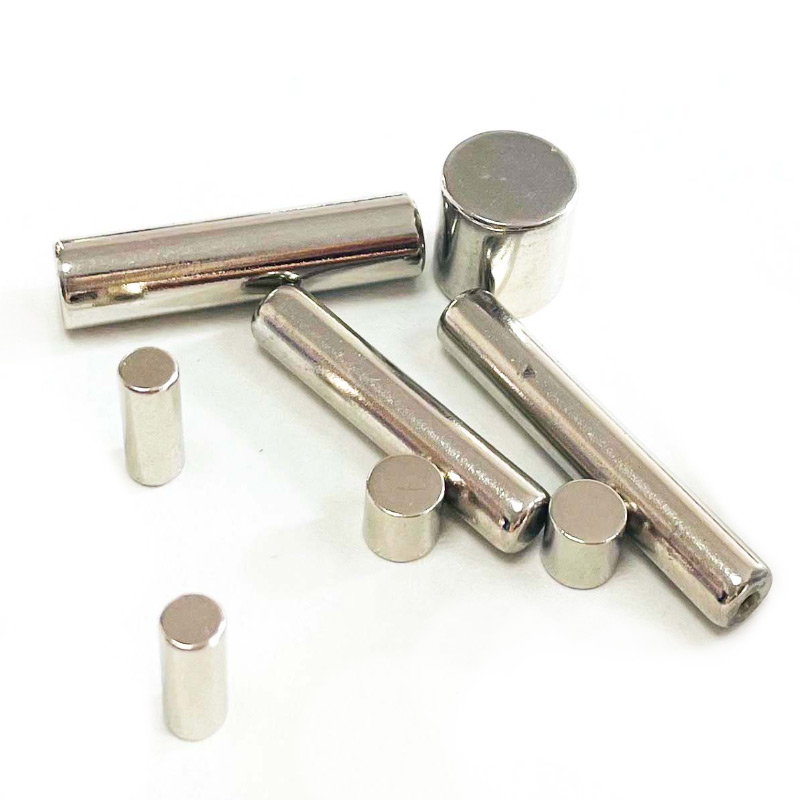
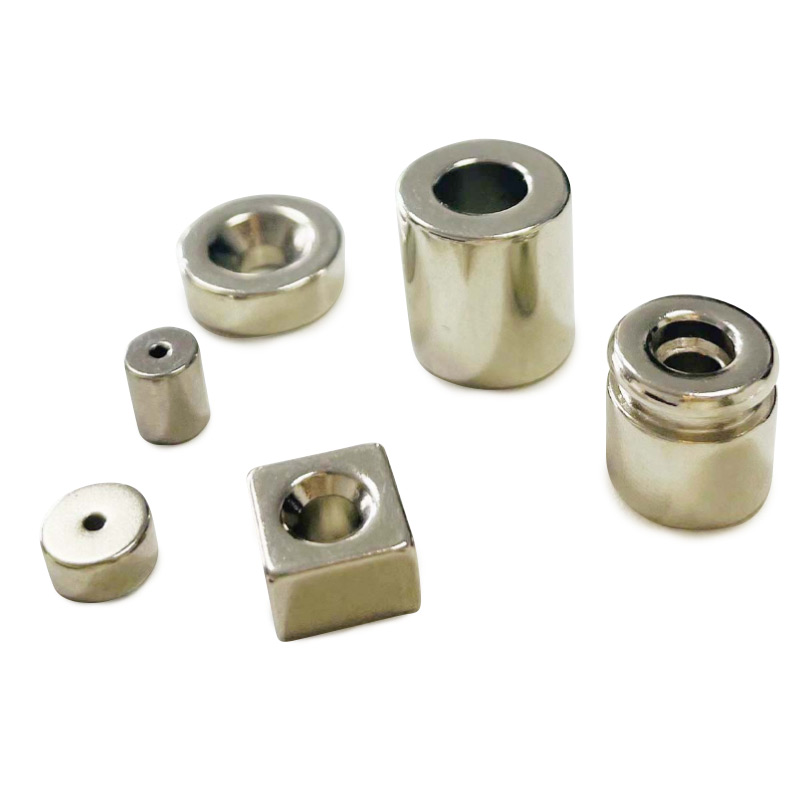
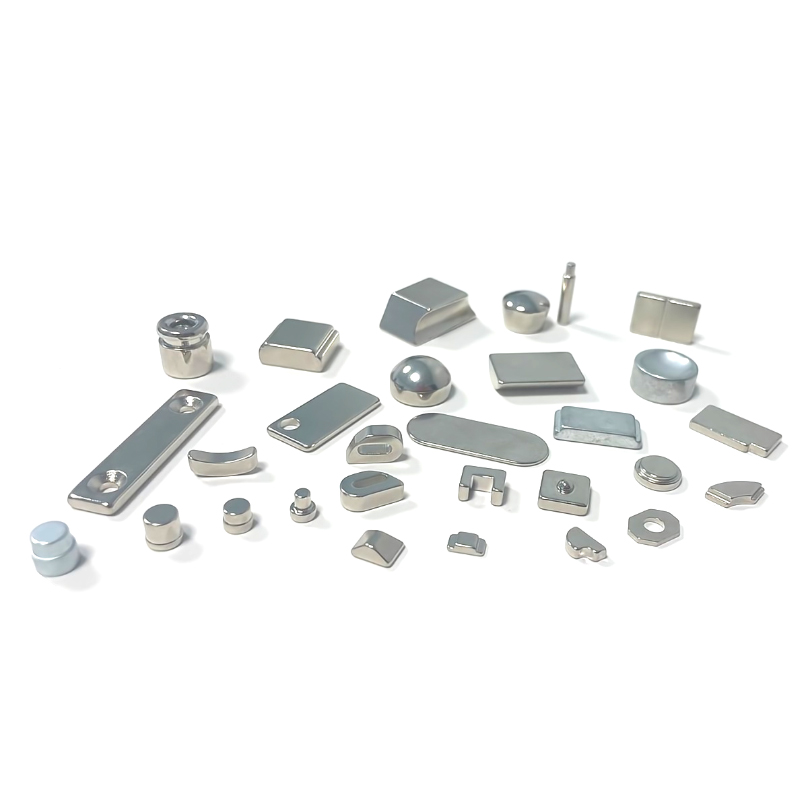
A capable NdFeB magnets manufacturer supports far more shape variety than the disc geometry shown above, since real magnetic circuits rarely use only one form factor.
DiscSensors, small motors |
BlockSpeakers, linear actuators |
Arc / SegmentMotor rotors, generators |
Ring, multi-poleEncoders, BLDC motors |
RodSensor probes, tooling |
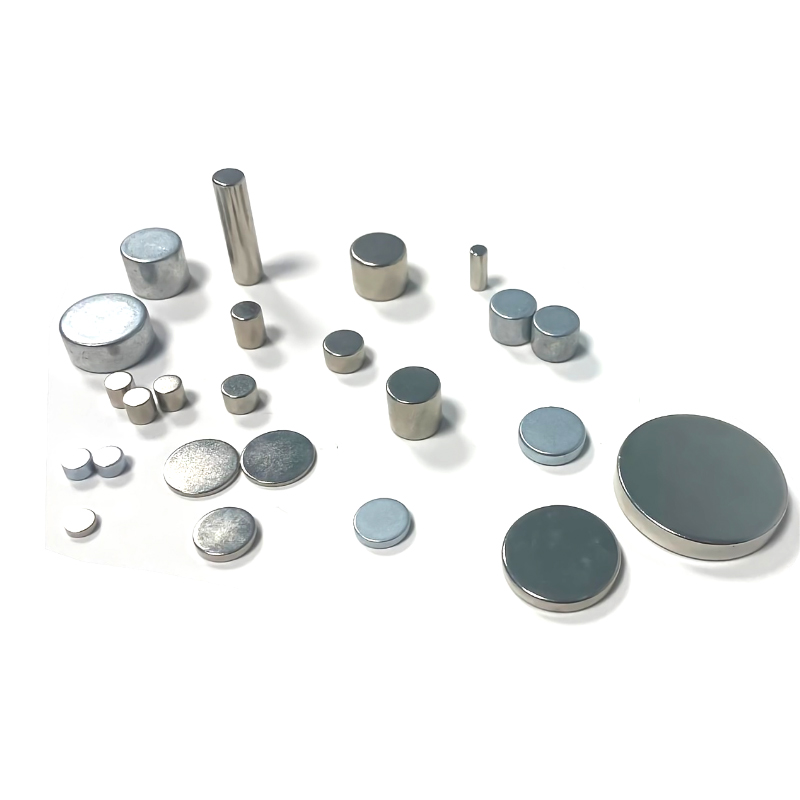
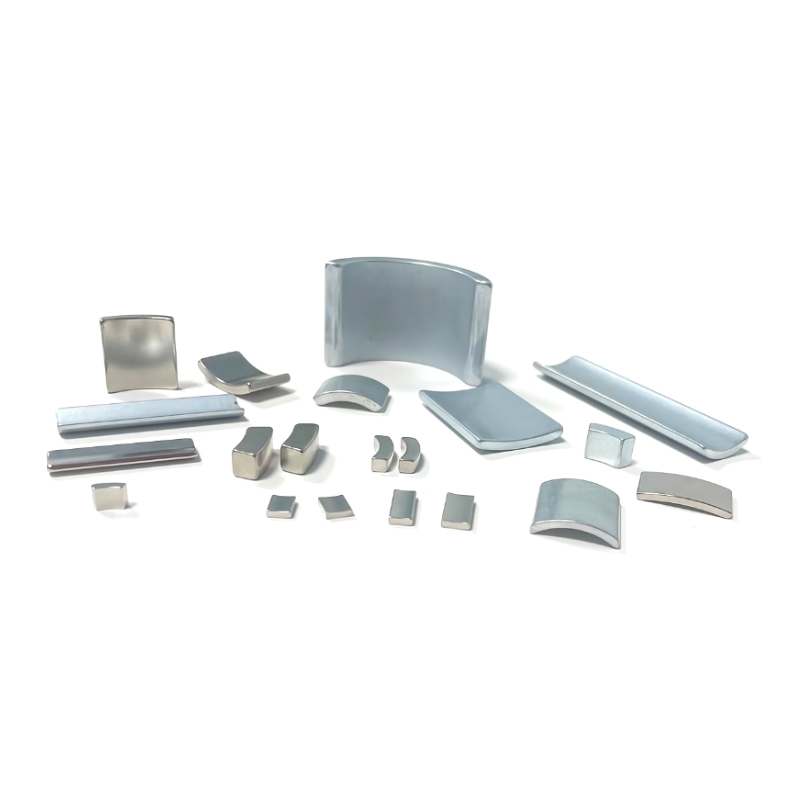
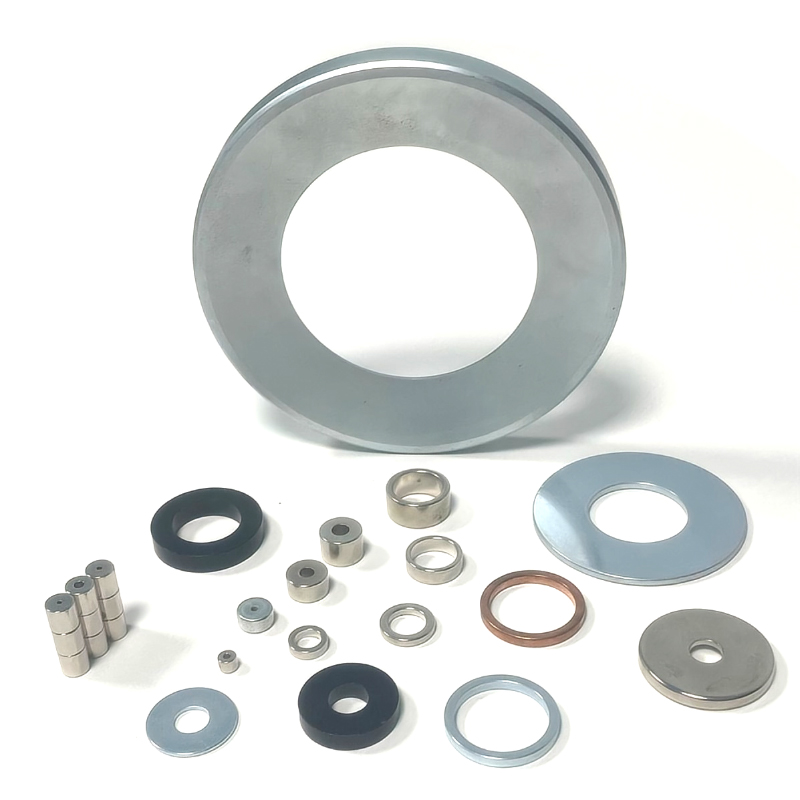
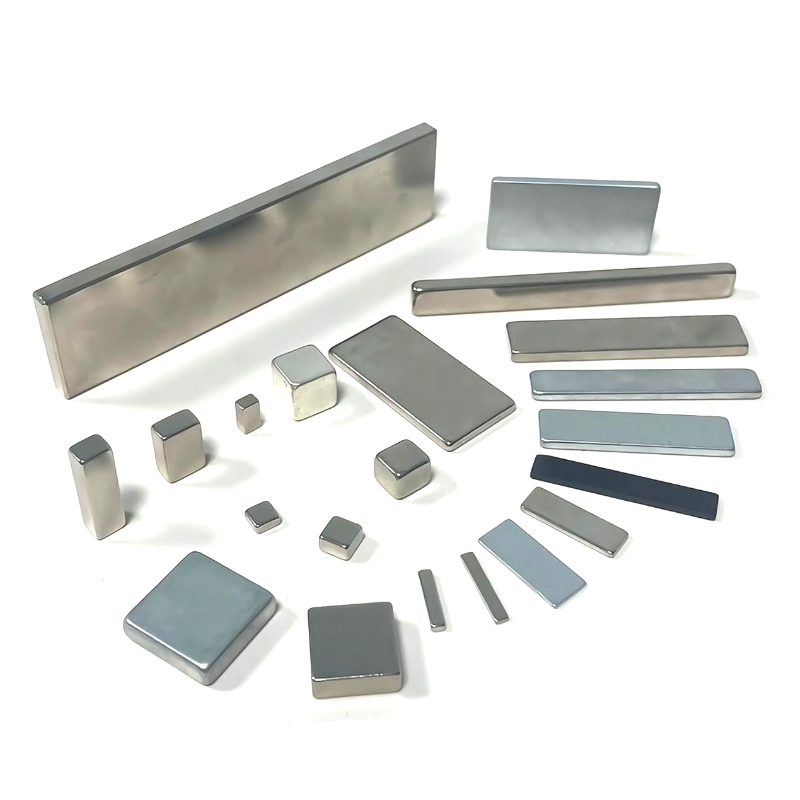
Arc and segment shapes are especially common in rotor assemblies because their curved profile follows the rotor bore, which improves the airgap flux distribution compared with flat blocks forced into a curved slot. Multi-pole magnetized rings are widely used in position sensors and small BLDC motors because a single ring can carry several alternating poles, reducing part count and simplifying assembly. Rod and block shapes remain common in linear actuators, audio transducers, and sensor probes where the magnetic circuit is straight rather than radial. A custom NdFeB magnets program benefits from working with a supplier that can move fluidly between these shape families without re-tooling an entire production line, since many end products require several shapes within the same assembly. This is also where coating choice interacts with geometry: thin arc segments with sharp edges are more prone to coating chipping during handling than thick discs, so edge treatment and packaging need to be adjusted shape by shape. Overall, structural understanding of orientation, coating, and shape is the foundation for every selection decision covered later in this article, including the comparison and maintenance sections.
Key takeaway: shape, coating, and magnetization direction work together as one system, and a supplier that can adapt all three in combination is better positioned to support complex magnetic circuits.
NdFeB magnets are used across a wide span of industries, and the selection criteria shift depending on whether the priority is thermal endurance, precision geometry, or long-term corrosion resistance. New energy vehicle traction motors, hub motors, and hybrid drive systems generally demand UH or EH grade material because of sustained heat exposure near the stator windings. Industrial automation equipment, including servo motors, permanent magnet synchronous motors, BLDC motors, robotic joint motors, and magnetic separation equipment, typically favors SH or UH grade material combined with tight dimensional tolerance for repeatable torque output. Home appliance and consumer electronics motors, such as AC compressor motors, washing machine motors, and energy-efficient fans, often perform well with M or H grade material since duty cycles are shorter and internal temperatures are more moderate. Medical and precision devices, including dental implant motors and medical instrument micro-motors, place a stronger emphasis on dimensional consistency and low variance between production batches. Energy and heavy machinery applications, such as solar pump motors, turbines, traction motors, and elevator traction machines, tend to require larger custom shapes with robust coating systems capable of tolerating outdoor or industrial-duty environments over extended service life.
| Application Category | Primary Selection Priority |
|---|---|
| EV traction / hub motors | High-temperature stability (UH/EH) |
| Servo / BLDC / robotic joint motors | Dimensional tolerance and repeatability |
| Appliance / compressor motors | Cost-efficient moderate-temp grades |
| Medical micro-motors | Batch-to-batch consistency |
| Solar pumps / turbines / elevators | Coating durability, larger custom shapes |
Before viewing the distribution chart, note that these five categories do not draw on magnet supply in equal proportion, and understanding roughly how demand is spread helps a sourcing team prioritize which selection criteria to focus on first. This is presented as a donut chart because the goal here is to show relative share across categories rather than a precise sequence or trend over time. The segments are illustrative groupings based on common industry usage patterns rather than a single specific dataset, and are intended to orient a buyer's thinking rather than serve as an exact forecast. Motor-related applications collectively make up the largest share across most manufacturing programs that request custom NdFeB magnets, which is consistent with the strong emphasis on thermal grade selection throughout this article. Reading the chart alongside the table above should make it easier to see why thermal performance dominates so much of the sourcing conversation for a motors magnet manufacturer.
The largest wedge in this chart represents EV and industrial traction motor applications, which lines up with the growing adoption of permanent magnet motors across new energy vehicles and hub-drive systems. Industrial automation is the second largest segment, reflecting steady demand from servo motors, robotic joints, and magnetic separation equipment used in manufacturing lines. Home appliance and consumer electronics motors form a meaningful but smaller portion, since these applications generally require lower-cost, moderate-temperature grades rather than premium high-temperature material. Medical and precision devices represent a narrower slice by volume, but they typically carry stricter tolerance requirements per part, meaning the value of consistency is disproportionately high relative to unit count. Energy and heavy machinery applications round out the chart with larger, often bespoke shapes that are ordered less frequently but at higher individual part sizes. This kind of segmentation matters practically because a rare earth magnets manufacturer that primarily serves one segment, such as consumer electronics, may not have the process controls needed to reliably serve EV traction or medical device programs. When comparing suppliers, it is reasonable to ask which segments make up the bulk of their existing production volume, since that history is a useful proxy for their process familiarity. A supplier with balanced experience across motor-related segments is often better equipped to support cross-application custom shape requests. It is also useful to recognize that demand mix shifts gradually as electrification and automation trends continue, so sourcing decisions should account for where a supplier's capacity investment is heading, not only where it stands today. Ultimately, this chart is best used as a conversation starter with a prospective NdFeB magnets factory about their relevant production history rather than as a strict allocation rule.
Key takeaway: selection criteria should follow the application category first, since thermal grade, tolerance, and coating priorities differ meaningfully between EV motors, industrial automation, appliances, medical devices, and heavy machinery.
Choosing between a standard-grade NdFeB magnet and a high-temperature motor-grade NdFeB magnet is rarely a single-attribute decision, since remanence, coercivity, corrosion resistance, and mechanical strength all move together as the material and coating change. A radar chart is a useful way to compare these attributes side by side because it shows the overall shape of the trade-off rather than isolated numbers. Before reviewing the chart, it is worth noting that these values are presented on a relative internal scale for comparison purposes rather than as absolute laboratory measurements, since actual performance varies by specific formulation and testing standard. The comparison below contrasts a standard NdFeB line against a high-temperature motor NdFeB line, which reflects the two product families most frequently requested by buyers evaluating a NdFeb Magnets manufacturer for motor programs. Five attributes are plotted: remanence, coercivity, maximum temperature resistance, corrosion resistance, and mechanical strength.
The two overlapping shapes in this radar chart show that high-temperature motor-grade NdFeB extends further along the maximum temperature and coercivity axes while remaining broadly comparable to standard grade on remanence. This pattern is consistent with how these materials are engineered, since raising coercivity and thermal stability typically involves adjusting rare earth composition and grain boundary treatment, which does not require sacrificing baseline magnetic output. Corrosion resistance shows a modest advantage for the high-temperature line in this comparison, which often reflects the more robust coating systems, such as multi-layer Ni-Cu-Ni or thicker epoxy layers, that are commonly paired with high-temperature formulations. Mechanical strength differences between the two lines tend to be smaller than the thermal and coercivity differences, since sintering density is usually optimized similarly across both product families. For a buyer evaluating a custom NdFeB magnets order for an EV traction motor, this chart visually reinforces why the high-temperature line is the more defensible choice despite standard grade appearing adequate on paper at room temperature. Conversely, for an appliance motor operating well within moderate temperature ranges, the standard line may deliver equivalent practical performance without needing the added coercivity margin. It is important to read this chart as a directional comparison rather than a precise specification sheet, since actual values should always be confirmed through the specific test report tied to a given production batch. Buyers sourcing from a rare earth magnets factory should ask whether the specific test data behind a radar-style comparison chart is available for the exact grade and coating combination being quoted. This type of visual comparison is most useful early in a sourcing process, when a team is deciding which product family to specify before requesting detailed technical datasheets. Once a family is selected, more granular grade-level comparisons, such as the temperature classification table earlier in this article, become the appropriate next step. Overall, the radar comparison and the temperature bar chart are meant to be used together, since one shows thermal classification breadth and the other shows how thermal upgrades relate to other magnetic and mechanical properties.
Key takeaway: upgrading to a high-temperature motor NdFeB line generally improves thermal and coercivity margin without a meaningful trade-off in baseline magnetic output, making it a reasonable default for motor-driven applications with sustained heat exposure.
Sintered NdFeB magnets are mechanically brittle and chemically reactive, which means handling procedures directly affect long-term performance regardless of how well the original grade and coating were selected. During incoming inspection, magnets should be checked for coating integrity, since chipped or scratched coating exposes the sintered core to moisture and accelerates corrosion over time. Magnetized magnets should be stored with keeper plates or in stacked arrangements that reduce stray field exposure, since scattered strong fields can attract ferrous debris that scratches coatings during storage and transport. Temperature cycling during storage should be minimized where possible, since repeated exposure to humidity swings can degrade coating adhesion even before the magnet is installed into its final assembly. During installation, magnets should be introduced into the magnetic circuit gradually rather than snapped into place at full force, since sudden mechanical shock can cause micro-cracking in the brittle sintered structure. For assemblies that will operate at the upper end of a magnet's rated temperature class, periodic performance verification during early production runs is a reasonable practice to confirm that real-world thermal behavior matches the grade specification.
StorageUse keeper plates, dry conditions, stable temperature. |
HandlingGradual assembly, avoid sudden impact. |
InspectionCheck coating integrity before install. |
Thermal CheckValidate grade against real duty cycle. |
Long-term reliability also depends on avoiding exposure to demagnetizing fields that exceed the design margin of the selected grade, which is why coercivity, not just remanence, matters so much in the earlier comparison chart. In field service environments, technicians should avoid placing loose NdFeB magnets near sensitive electronic equipment, magnetic storage media, or pacemakers, since even coated magnets retain strong external fields. When magnets are part of a larger assembly that will undergo maintenance or disassembly, care should be taken to avoid dragging magnetized surfaces across metal tools or debris, since this is a common cause of coating wear during routine servicing. For multi-pole magnetized rings used in encoders, mechanical stress during disassembly can also disturb pole alignment, so replacement is often more practical than attempting field repair. A responsible neodymium magnets factory typically issues handling guidelines specific to the grade and shape shipped, since a thin arc segment and a thick disc magnet do not tolerate the same handling force. Working with a magnet manufacturer that documents these procedures reduces the likelihood of field failures being misattributed to material defects when the underlying cause was handling damage. Overall, maintenance for NdFeB magnets is less about active servicing and more about preventing avoidable mechanical and chemical damage across the storage, installation, and service lifecycle.
Key takeaway: most NdFeB performance issues in the field trace back to handling and coating damage rather than the underlying magnetic material, making careful storage and installation practice a practical extension of grade selection.
Everything discussed above, from grade selection to shape customization to handling guidance, depends on partnering with a manufacturer capable of executing consistently at production scale. Ningbo Tujin Magnetic Industry Co., Ltd is specialized in the manufacturing and sales of high-performance NdFeB magnets, with a focus on high-temperature-resistant motor magnets and customized magnetic solutions built around precision and stability. As a neodymium magnets manufacturer serving motor and industrial customers, the company's NdFeB magnets are engineered to maintain magnetic performance across a wide temperature range, from around negative forty degrees Celsius up to two hundred degrees Celsius or higher, which aligns directly with the UH and EH thermal classes discussed earlier in this article. This makes the product line applicable across new energy vehicle traction and hub motors, industrial servo and BLDC motors, robotic joint motors, magnetic separation equipment, home appliance compressor and washing machine motors, medical instrument micro-motors, and heavy machinery such as solar pump motors, turbines, and elevator traction machines.
As a custom NdFeB magnets factory, the company supports complex and precision shape requirements, including disc, block, arc segment, multi-pole magnetized ring, and rod geometries, which map directly onto the shape families illustrated earlier in this article. Its focus on mid-to-high-end magnets is paired with advanced coating systems, including Ni-Cu-Ni and epoxy options, aimed at improving oxidation resistance and extending service life in demanding environments. Streamlined workflows from design through mass production are intended to support shorter lead times, which matters for customers coordinating magnet delivery against broader motor or equipment assembly schedules. Beyond motor applications, the same production capability extends to audio magnets for speakers, sensor magnets, and wind power components, reflecting the shape and coating flexibility described in the structural section above. For companies comparing a NdFeB magnets manufacturer, a rare earth magnets manufacturer, or a NdFeB magnets factory for an upcoming motor or precision device program, evaluating a supplier's thermal grade range, shape customization capability, and coating options together, as outlined throughout this article, is a practical way to narrow the field before requesting detailed technical quotations.
Key takeaway: a supplier that can align thermal grade, custom shape, and coating capability under one roof reduces coordination risk for motor and precision-device programs compared with sourcing these elements separately.
Q1: What is the difference between a neodymium magnets manufacturer and a rare earth magnets factory?The terms largely overlap, since NdFeB is the most widely produced rare earth magnet type. In practice, both terms describe a facility that sinters, magnetizes, coats, and finishes NdFeB magnets to customer specifications, though some facilities also handle other rare earth compositions. |
Q2: Which grade suffix should I choose for a motor operating above 150°C?For sustained operation above 150°C, UH or EH grade material is generally more appropriate than M, H, or SH grades, since these higher thermal classes maintain magnetic output with a larger margin under continuous heat exposure. |
Q3: Can a custom NdFeB magnets order include multiple shapes in one project?Yes. Many motor and equipment assemblies combine several shapes, such as arc segments in a rotor paired with a multi-pole ring for a position sensor. A capable manufacturer should be able to support multiple shapes within a single custom program. |
Q4: Why does coating matter as much as magnetic grade?Sintered NdFeB is chemically reactive, so the coating protects the core from oxidation and corrosion. A high magnetic grade with a weak or damaged coating can still fail prematurely in field service, so both factors should be evaluated together. |
Q5: How can I evaluate a NdFeB magnets supplier before placing a custom order?Review their grade range, shape and coating flexibility, and production history across application categories similar to your own. Requesting sample parts and technical datasheets for the specific grade and coating combination is a practical next step before committing to volume production. |

Having a blueprint in mind, working hard and forging ahead
 No.107 Yunshan Industry Park, Sanqishi Town, Yuyao, Ningbo, Zhejiang 315412, China
 +86-18858010843
 sales@tujinmagnet.com
Copyright ? Ningbo Tujin Magnetic Industry Co., Ltd. All Rights Reserved. Custom Rare Earth Magnets Factory