-

sales@tujinmagnet.com
-

+86-18858010843
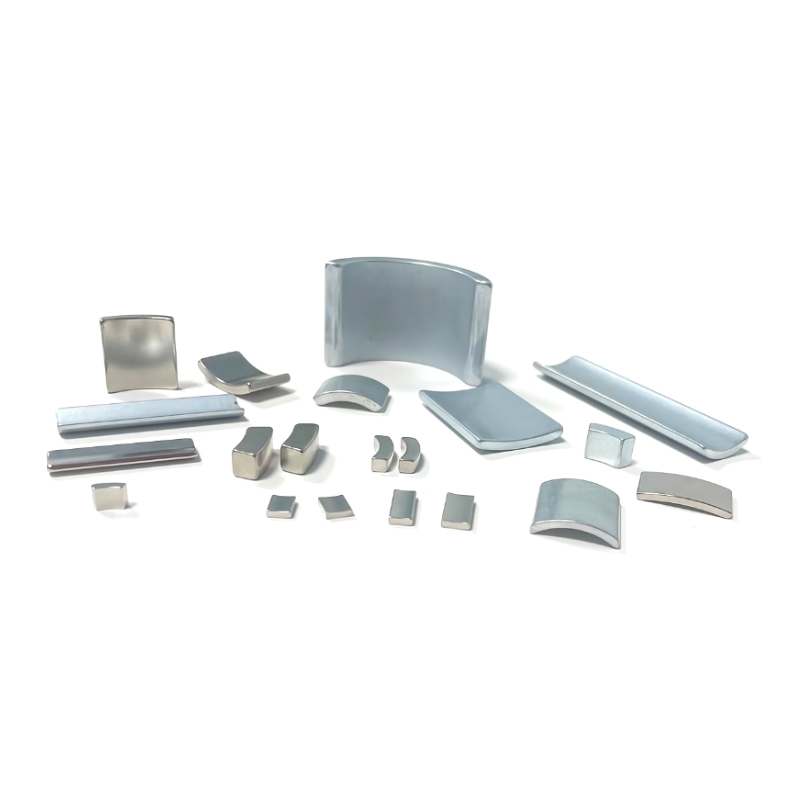
Neodymium Arc Magnet is also called curved magnets, commonly used in various permanent magnet DC motors, servo motors, Bldc motors, driving motors, etc.
A servo motor engineer opens the incoming magnet test report and looks for one curve long before he checks any other number: the ...
READ MORECobalt magnetization is the reason a permanent magnet can keep delivering full flux inside a traction motor at 200 °C, hour after...
READ MOREWhat Are Alnico Magnets? Alnico magnets are permanent magnets made primarily from aluminum, nickel, cobalt, and iron, with small ...
READ MOREWhy NdFeB Magnet Composition Is the First Thing to Check When a procurement engineer receives two quotations for the same N42SH g...
READ MORENeodymium arc magnets (also known as bent magnets) are a special form of neodymium iron boron (NdFeB), currently the strongest rare-earth permanent magnet material. Their design and applications primarily revolve around efficient rotating machinery and precision motion control systems.
The main application of neodymium arc magnets is as permanent magnets in various motors or electric motors. Due to their high magnetic energy product and unique arc-shaped geometry, they can generate a strong and stable working magnetic field within a compact space, which is crucial for improving motor efficiency.
Due to their outstanding contribution to torque and rotational force stability, neodymium arc magnets are widely used in the following demanding rotating machinery and systems:
Serving as stator poles, providing a stable excitation magnetic field.
This is one of the most common applications of neodymium arc magnets. The magnets are typically mounted on the rotor, and drive is achieved through electronic commutation. They are central to products such as electric vehicles, drones, and high-performance fans.
Used in automated equipment requiring precise position and speed control, such as industrial robots and CNC machine tools.
Widely used in high-power-density equipment such as new energy vehicles and power tools.
The arc-shaped design of neodymium arc magnets perfectly matches the cylindrical structure inside motors and generators, resulting in a more rational and concentrated distribution of magnetic field lines.
Arc magnets are typically installed on the inner wall of the stator (stationary part) or the outer edge of the rotor (rotating part).
Through the interaction of the strong, stable magnetic field they generate with the electromagnetic field generated by the energized coils, electromagnetic force (Lorentz force) is produced, thereby realizing the mutual conversion of electrical energy and mechanical energy:
Motor Mode: Electrical energy is converted into mechanical energy, generating torque to drive the rotor to rotate.
Generator Mode: Mechanical energy is converted into electrical energy.
Using radially magnetized neodymium arc magnets can maximize the utilization of magnetic flux, thereby improving the power density and efficiency of the motor and reducing energy consumption. Neodymium arc magnets are key to achieving high performance, miniaturization, and high efficiency in modern electric motors.
Radial magnetization is a specific magnetization method for arc-shaped or toroidal magnets.
The magnetization direction of a magnet is radial, either outward or inward from its center.
For arc magnets, the inner and outer arc surfaces become the magnet's two magnetic poles (N and S poles), respectively.
This allows magnetic field lines to originate from one arc surface, pass through the air or rotor/stator in between, and reach another arc surface, forming an ideal toroidal magnetic field, which is precisely what an electric motor needs to operate.

Having a blueprint in mind, working hard and forging ahead
 No.107 Yunshan Industry Park, Sanqishi Town, Yuyao, Ningbo, Zhejiang 315412, China
 +86-18858010843
 sales@tujinmagnet.com
Copyright ? Ningbo Tujin Magnetic Industry Co., Ltd. All Rights Reserved. Custom Motors Magnet Factory

 English
 русский
 Español